
Tucked away in an old supply closet, not too far from the machining shop, the Robotics and Automation Club gathers twice a week at the Interurban campus with the goal of breathing life into a humanoid robot some five years in the making. This student-led organization strives to remove the barriers of entry, encouraging anyone who’s interested in robotics to come and give it a try.
“We like to get people interested in robotics,” says club member Owen Brady, “so I think that, for that, you have to showcase your work, show that it’s worth it, and show that what you’re learning in class and the skills you’re applying to robotics club are actually getting somewhere.”
The club is made up largely of engineering students, although that’s not the only demographic that they welcome. The objective is to make themselves as accessible as possible and lower the barriers of entry to anyone who’s interested.
“There’s no hard deadlines, there’s no requirements,” says club member Cody Pargee, “so the lack of hierarchy gives it a flexible structure. There’s no interview process to come in. I mean, it’s very open-source and collaborative.”
Even those in more specialized areas of study are constantly learning from one another, utilizing the software and materials that are already made available to them.
“SolidWorks is a big one for modelling all the 3D printing components,” says Brady. “It’s an industrial-grade piece of software that we have access to for free, so we like to use that. And then there’s also the machine shop, so if we wanted to actually mill or lathe or make some piece of metal, we have access to that too.”
Many of the club’s resources, beyond what their programs provide, can be accessed through Camosun Innovates, the applied research branch of the college that strives to make manufacturing equipment and technology more accessible to students, as well as to the broader community.
“If you’re into 3D printing as a hobby, you could go in there and see a $100,000 3D printer and say, ‘Oh, so my hobby has a translation into an industrial use,’” says Pargee. “Like, people manufacture aerospace and automotive parts. So, I’m just using that as an example of transitioning our skills and enthusiasm into actual, real-world, high-paying jobs. It’s a good bridge between the theoretical.”
And oftentimes, the theoretical can become practical. Rob Bartnik, an emeritus member of the Robotics and Automation club, is an example of the many successes that can be found in specialized, student-led organizations such as this.
“Having the robotics club meant that I could use what I learned as part of a capstone project to raise wheelchairs upstairs,” says Bartnik. “And that then led to a co-op work term with Ocean Networks Canada—one of the country’s leading research institutes—maintaining Wally, an actual Benthic Crawler; a thing that maintains networks miles under the sea. So I got to do some maintenance on that, and all of that came from a little bit of time spent working with people who just wanted to know a little bit more about robots.”
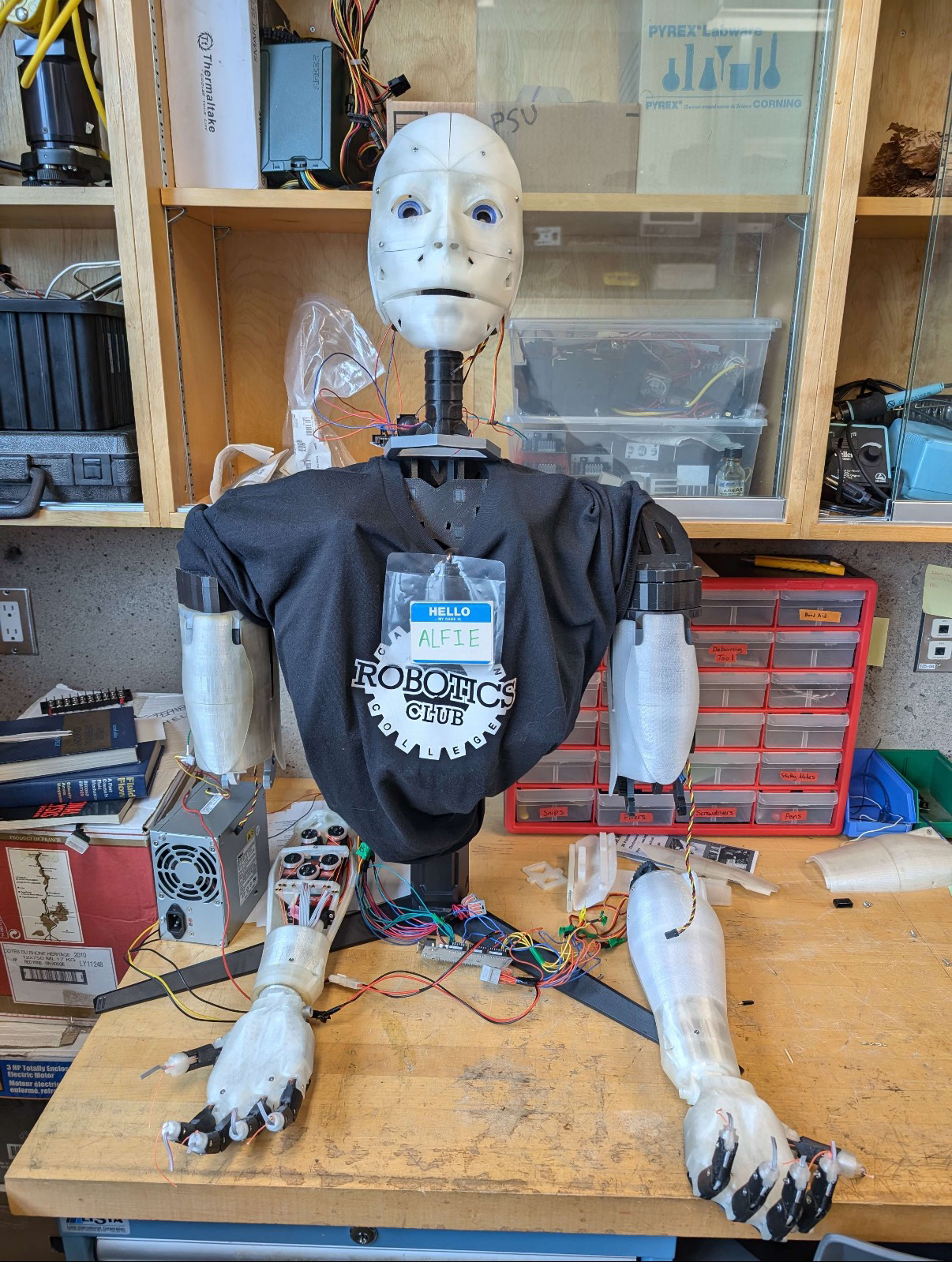
As for the club’s own projects, they’re currently working on a humanoid robot called Alfie, which is now in its fifth year of development, alongside MARC, a modular rover which entered development last semester. And while the club has big plans for both of these projects, their sights have largely been set on MARC as their primary focus.
“We have another output for MARC, specifically, which is to make it sort of like an open-source modular rover,” says Brady. “So we have an end goal, which is that we’d like to eventually submit an online package that people can download and build themselves. So there’s an actual goal output for some of the things we do here as well.”
With anyone welcome to join, the club has fostered a strong balance between learning and teaching, hoping to dissolve the fear often associated with trying something new.
“You come in here and you can see that it all starts at the very beginning,” says Pargee. “It’s not as impossible as you might think because you can see all the individual systems that go into it and how they’re developed. It doesn’t start as a finished project. There’s all sorts of steps to get there, and seeing those in action I think can take away some of the fear and the ‘I can never figure this out’ aspect to it.”
See camosunstudent.org/all-groups/robotics-and-automation-club for more info.