
Camosun Visual Arts graduate Erin Berry recently won a national award for emerging ceramics artists: the Winifred Shantz Award, worth $10,000.
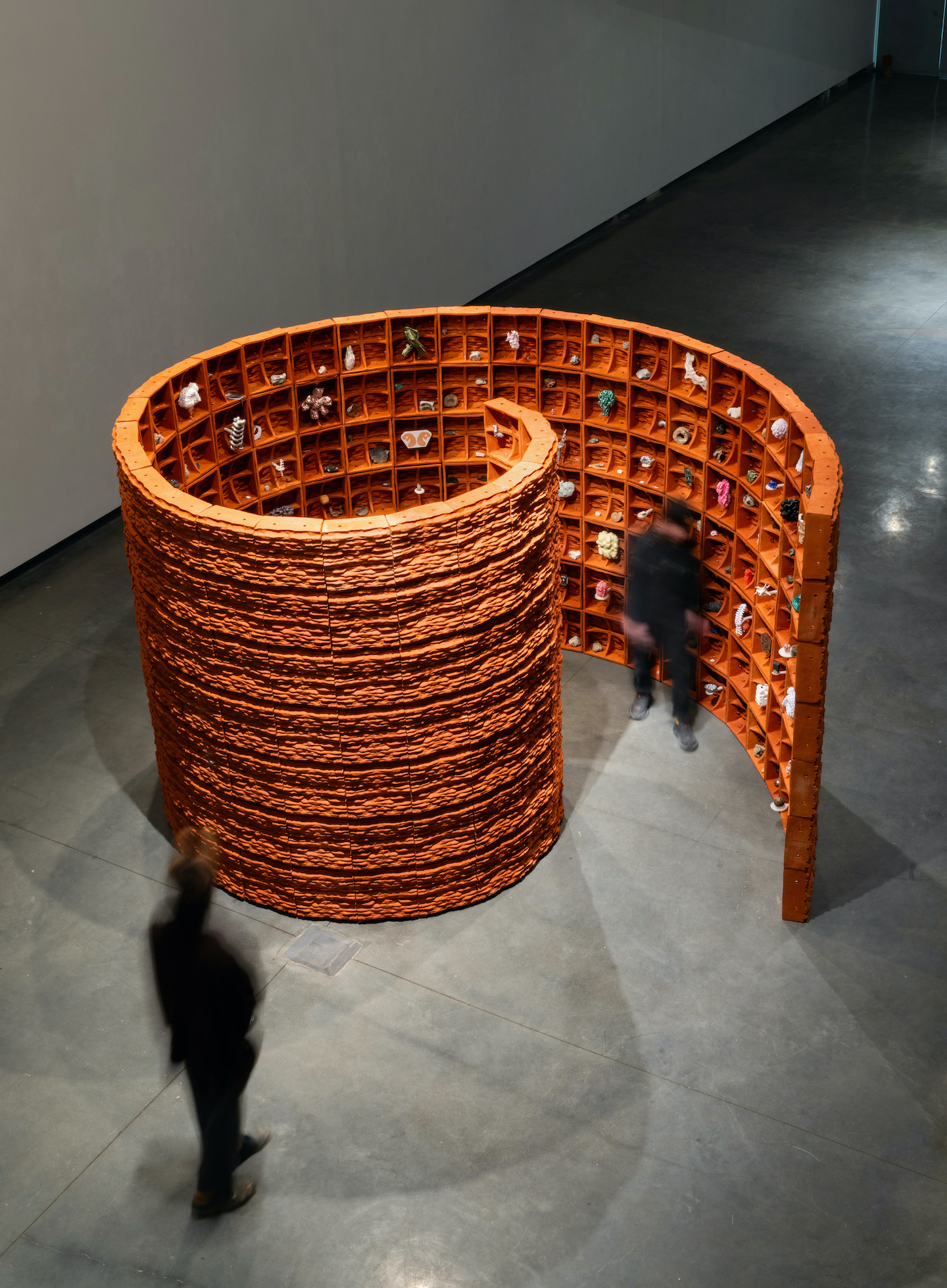
The award recognizes her master’s thesis piece, Hyperprocess, a large walk-in spiral made from 238 ram-pressed bricks. The installation functions almost like a library of artifacts containing everything from fossils to computer chips alongside Berry’s own ceramic works, creating a complex and immersive narrative piece.
Berry was introduced to clay by her grandmother, a production potter, who taught her how to work with clay and provided her with the equipment to set up her first studio at her parents’ house. There, she was able to hone her skills before attending Camosun, where she began to work on larger pieces and sculptural ceramics pieces.
“In [high school], she asked if I wanted to learn how to work with clay,” says Berry. “She taught me how to throw in a little porch area at my parents’ house, [where] we set up a little studio. Eventually, I ended up getting the old kiln off [my grandparents]… but the first sculptural ceramics I did was at Camosun.”
After graduating from Camosun in 2012, Berry moved to Montreal to pursue sculptural ceramics at Concordia University. But her path took a detour when a spot on the National Sailing Team led her to take three years away from school to focus on making it to the 2016 Olympics. Her sailing career was cut short when she got a severe concussion during an event in France in 2015; after recovering, her focus shifted back to ceramics, leading her back to Concordia and eventually to Alfred University in Upstate New York.
“Alfred is a very highly regarded university for ceramics,” says Berry, “the calibre of… graduate work coming out of [there] is really incredible… My thesis work, Hyperprocess, could have only happened at Alfred; I don’t think there’s any other university in North America where I could have made that work.”
Aside from the demanding technical aspects, Hyperprocess is an exploration of human connection with geological “deep time.” The name is partly inspired by Timothy Morton’s concept of “hyperobjects,” which refers to things so vast—like global warming or the Earth—that they cannot be fully perceived from one angle. During her first year at Alfred, Berry took 3D scans of local shale walls that were remnants of a 300-million-year-old ancient seabed. These scans became part of the exterior texture of her bricks, referencing the origin of the town of Alfred and the clay industry in New York, which exists due to these shale deposits, and geological sedimentation as an archive of the processes that happen on earth.
“Where does the iron in our blood come from?… Was it once within the core of the earth? We often as humans think of ourselves as separate from the processes that are constantly happening in the earth and from time itself,” says Berry. “If you look at the processes of deep time, we are very small and insignificant… it’s healthy to keep that perspective.”
Now back in Victoria, Berry is continuing to work on pieces in preparation for an upcoming exhibition in Toronto. While she was aware of the Winifred Shantz Award before winning it, her main focus was on bringing to life the concept she had for Hyperprocess, as well as continuing to maintain a high calibre of work.
“I wasn’t thinking, like, oh, this work is going to win awards… I was mainly thinking about the conceptual side of it at the time and kind of really pushing that. I’m really honoured because I feel like I’m among some really incredible artists that I really admire who have won this award in the past.”
For now, Berry continues to embrace the unknowns of the early stages of an art career, advising young artists to “make work that makes you a little uncomfortable. There’s usually something there. Don’t let judgments from exterior voices prevent you from making the work you really feel you should be making. There’s always going to be people that don’t like your work or don’t understand it—and then on the other side, there’s people that really need to see it.”