The folks at Camosun Innovates—Camosun College’s applied research branch, located at the Interurban campus—have worked in many fields of study in the recent past, including medical technologies, marine innovations, and adaptive sporting equipment. Now, they’re delving into the area of cultural heritage preservation, with a technological twist.
Local Indigenous master carver and UVic impact chair for Indigenous art practice Carey Newman, Camosun Innovates director Richard Gale, and UVic Mechanical Engineering associate professor Keivan Ahmadi recently received a grant from the New Frontiers in Research Fund Exploration Stream. The grant—which is given to high-risk, high-reward interdisciplinary research going past traditional disciplinary boundaries—is being used to support the preservation of Indigenous carving traditions. With a robot.
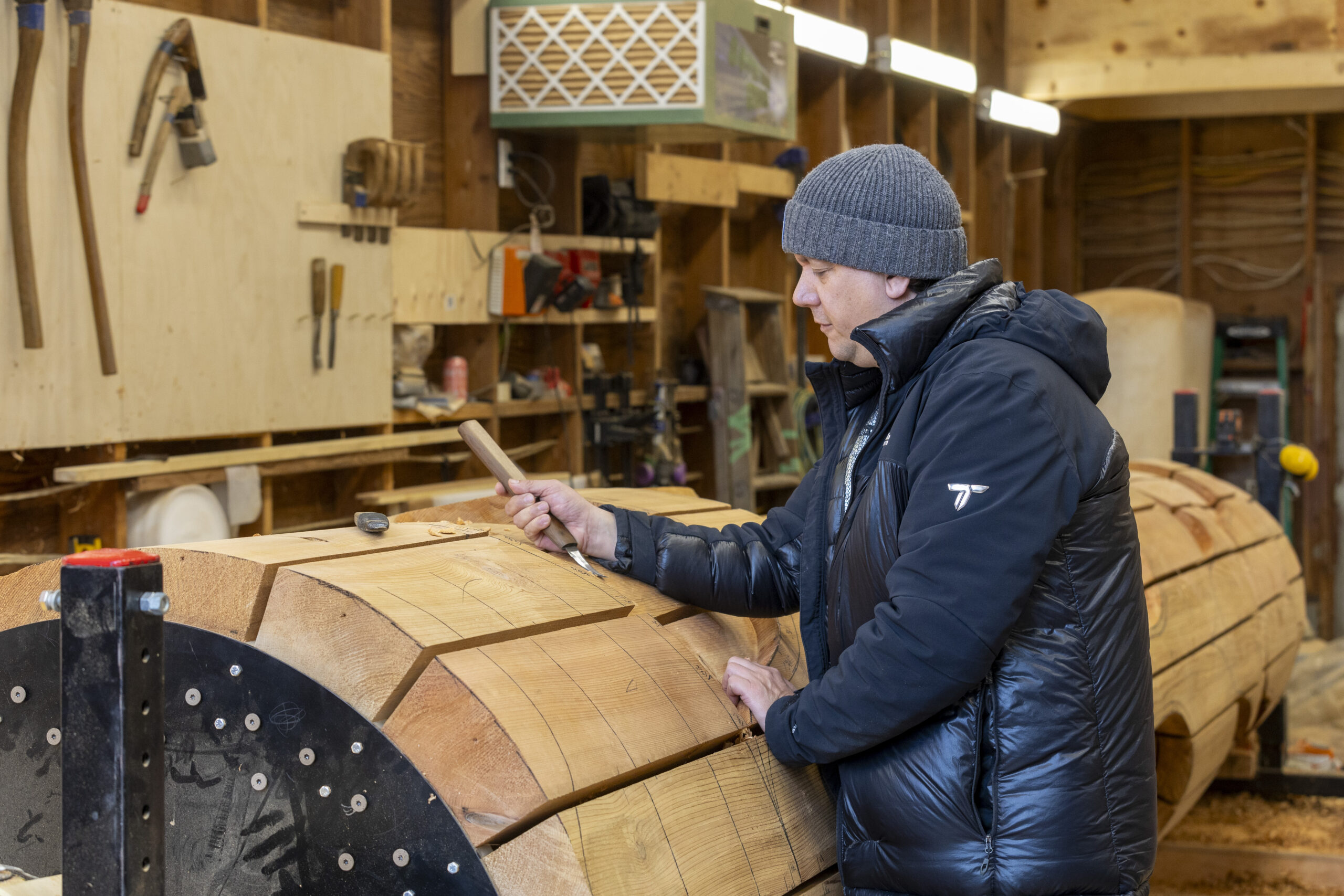
“Wood grain has variable densities,” says Newman. “It has different directionalities, so it makes it more difficult to train a robot, or to program something to carve it. On any any given board of wood, you might, as a carver, put your knife down and you start to carve in one direction and it might be what we call the direction of grain, uphill or downhill. You might be going uphill, which means the knife is digging in, whereas if you reverse the direction of your cut you have control of how deep the knife goes, and it comes out naturally because it’s not that the grain is forcing it to dig in.”
However, when trying to explain all of this to a robot that has generally been used for less organic materials in the past, the team had to figure out an entirely new approach.
“So if it’s carving a composite material or plastic, it’ll just use the amount of force necessary to create the chips that you’ve programmed,” says Newman, “but for it to be reactive or responsive to the conditions of the [wooden] material, the directionality of the grain, you have to teach it to understand when the knife is digging in and [going] inside and [how] to do that, right?”
Cameras will be recording the visual aspects of what Newman and other carvers are doing during the process, while, simultaneously, the knife will be recording the pressure being applied, as well as the amount of material being carved.
“If you’ve asked it to make a chip, and it’s not able to make the chip in the direction that it starts out, then it tries the other direction, which is kind of how we do it as carvers,” says Newman. “[In this way] we can teach a robot to sense when the blade is not doing what it’s intended to do.”
Newman says that it’s important to everyone involved in this project that this doesn’t become about replacing traditional ways of carving, and that this technology stays in the proper hands.
“One of [the ways to ensure this is done] is to… put the control of how the carving mechanism of the robot is used into the hands of community, of the First Nations community, so it’s by, essentially, through exercising data sovereignty,” says Newman. “And so, in this case, for me, it means ensuring that the ability to use a robot to carve using the data gathered from First Nations is used to benefit First Nations carvers, not to replace them.”
In this way, says Newman, it could ensure that traditional Indigenous ways of carving are held in perpetuity for future generations, and that the risk of it becoming a lost art is mitigated.
“That’s exactly how we’re positioning it,” says Newman. “When it comes to carving, the robot won’t be trained to carve; it will be trained to teach.”