
I’m officially counting down my final days here at Camosun. Once this semester is through, I’ll be at a different school in a different city, living what I assume will be more or less the same life, but one that, for all intents and purposes, will be different too.
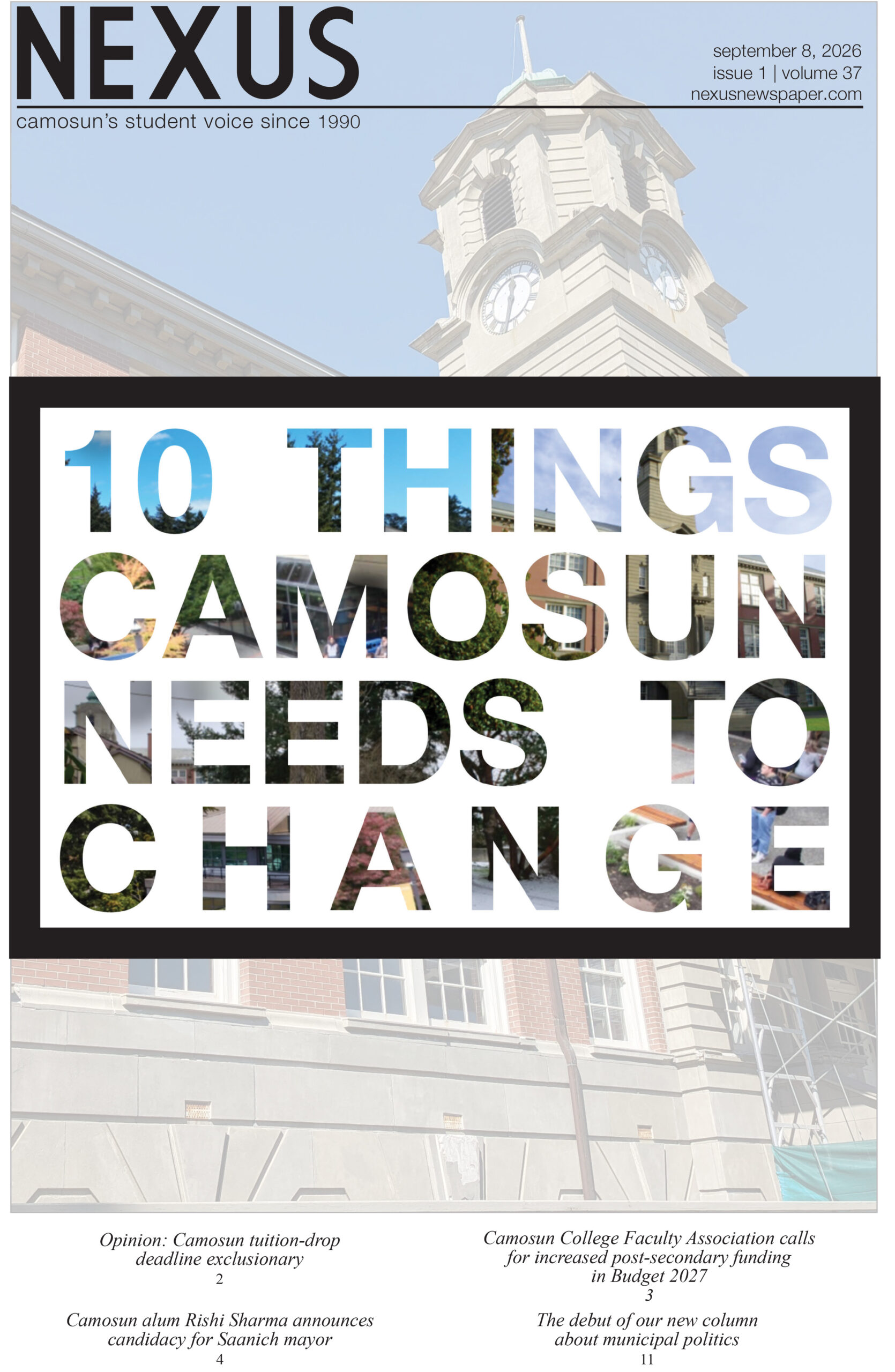
While I’m excited to start this next chapter of my life, I can’t help but feel a little nostalgic for the place where my post-secondary career began. Here at Camosun, I’ve gained knowledge and experience and formed friendships that’ll last a lifetime. I can also confidently say I became prepared for whatever academic challenges lie ahead of me. And yet, as I reflect on my time here, I can’t help but dwell on the handful of areas where I feel Camosun falls short. I couldn’t find a suggestion box (although, admittedly, I wasn’t looking very hard) but I figured what better way to say farewell before I pack up my bags than with a loud-mouthed parting gift?
10. Campus life
When it comes to campus life, Camosun is in a pretty tough spot; most of us here have jobs, families, or any number of commitments that must fit alongside our studies. We’re a pretty hard-working bunch; unfortunately, that also means that socializing with our classmates doesn’t often take top priority (or even second, for that matter).
Still, I think it’s important to remember that not everyone operates that way. Many students arrive here fresh out of high school and focus all of their attention on post-secondary education. So, shouldn’t we prioritize some kind of campus life for them, if not for all of us?
Camosun has every opportunity to host events and activities that cultivate community, be it live productions, game nights, friendly competitions, or recreational sports. However, by failing to create these opportunities for connection, Camosun ultimately fails its students too.
The Camosun College Student Society (CCSS) does its part in putting on events; it’s up to the students to come support them to ensure they keep happening.
9: Clubs
Going beyond campus social events, I’d also like to talk about Camosun’s wildly underwhelming club scene. If you look at the CCSS club directory, you might find that a great deal of the clubs are practically dormant. Well, okay, “dormant” might be a little bit dramatic, but my point still stands. In fact, I’ve had several friends try to join these campus groups just to be stood up.
Now, admittedly, this is less of a Camosun issue and more of a student-engagement issue. You see, the clubs here are primarily student-led, with some oversight and support from the CCSS.
My suggestion? Get a third party involved. Faculty members, industry professionals, you name it. Granted, more casual groups like the Nintendo club probably don’t need any more oversight than they already have; something tells me they’re not exactly hurting for members. But more academic groups, like the psychology club, would likely benefit immensely from having someone with higher education or real-world experience involved.
And let’s talk about a different issue I’ve noticed with Camosun’s clubs: marketing.
Poor marketing does absolutely nothing to increase student engagement. I mean, how many people at Camosun don’t even realize we have clubs, let alone interesting ones like knitting, martial arts, Dungeons & Dragons… the list goes on.
If you ask me, Camosun is in desperate need of a functional network where students can connect over shared interests and hobbies. So, hey, if you’re looking for something to get involved in this semester, you might consider joining a club—or, alternatively, create your own. All you need are five students and a half-decent idea.
8. Lansdowne dining options
I think we can all agree that the dining options at Lansdowne are downright abysmal. In fact, let’s list them off: there’s Campus Caf in the Fisher Building, the coffee shop in Wilna Thomas, and that’s it. Unless, of course, you include Dunlop House, although I’ve never met anyone who’s actually been there, much less in between classes.
This sparse reality is utterly ridiculous. I mean, sure, you can get a pack of instant ramen from the bookstore or a bag of chips from a vending machine (assuming you find one that actually works), but are those really our only alternatives?
Comparatively, Interurban campus has five distinct dining spots—six if you include their pizza vending machine, and seven if you include the ClassRoom Restaurant. Talk about a Lansdowner.
Now, it’s important to note that the Hillside Shopping Centre is only a 10-minute walk away from campus, featuring a bountiful food court that students can explore (well, depending on your definition of “bountiful”). But, in any case, I would argue that trekking off-campus is only a viable option if you have an extended break between classes, and that’s just not a luxury that a lot of students have.
So why not revamp the empty cafe space beside the library? Or bring some of the Culinary students to Lansdowne? It’s my hope that after my departure these questions may be answered.
7. Transportation
I’m sure most of us are familiar with the illustrious UVic bus exchange. As the second-largest transit destination in Greater Victoria, it accommodates roughly 25 percent of all local transit trips, with at least 14 bus routes passing through each day. Now, to put that number into perspective, Interurban and Lansdowne each get around half a dozen bus routes servicing them.
Of course, Camosun is smaller than UVic, so a direct comparison may be a little unfair, but it does highlight a clear issue with the infrastructure in and around Camosun that needs to be addressed.
Interurban is widely considered to be a commuter school and therefore must have a little more to offer in terms of parking, whereas Lansdowne just lost an entire lot to make room for the new student housing project. Now, ultimately, I think having affordable student housing is a net-positive for both the school and the community. However, I also think that if Camosun is actively reducing parking spaces for students, they should also be responsible for advocating for better public transit to pick up the slack. Of course, the college isn’t entirely at fault for this (municipal transit gaps do seem a little bit out of their jurisdiction), but they have a duty—or should have, at least—to advocate for their students.
6. Academic Advising
Alright, here’s where my critique gets personal. I started my journey as a University Transfer student about a year ago, knowing good and well that I’d eventually land myself someplace else. And as I’ve lived in Victoria my whole life, I’ve always known that UVic was the last place I wanted to continue my studies. I wanted to do my own thing; broaden my horizons. So, after careful consideration, I finally found a school that seemed like the perfect fit for me and promptly booked a meeting with an academic advisor to ensure that my course plan was on the right track.
It didn’t take long for them to inform me that they mostly dealt with UVic transfers and had very little knowledge of the institution that I had planned to attend. So, we sat in their office staring at the BC Transfer Guide for about 30 minutes before they finally concluded that I was on the right track — no advising needed. And while I did feel a little reassured by that, I also felt dumbfounded. Like, why did I even bother booking this appointment?
I look back on that meeting now as nothing more than a laughable waste of time, especially considering it took weeks just to get the appointment (the process as gruelling as it is inefficient). So, I’d like to offer something of a proposal for the Academic Advising department: the online booking system used to set up appointments should require students to provide their major and school(s) of choice, rather than just their faculty. Specificity helps everyone, and giving advisors access to this information ahead of time would allow them to prepare more effectively for their meetings with students. Everybody wins.
5. Counselling services
From my very first day at Camosun, I found it strange that there was no online booking option for student counselling services. If you need support, your only options are to phone the office or to show up in person. There’s no two ways about it. (Or, there’s only two ways about it.)
But there’s one small issue: as I mentioned earlier, a pretty good portion of Camosun’s student body works while attending classes, so many people don’t have the flexibility to schedule an appointment during office hours.
Beyond scheduling conflicts, many students who need access to professional counselling might not be comfortable walking into a physical building or speaking with a stranger over the phone. While those things may not seem intimidating to everyone, they are petrifying for others.
The point that I’m trying to make here is that if our massage-therapy clinic can implement an online booking system, then surely our mental-health services can do the same.
There was a time in my life when I would have greatly benefited from counselling, but if the only way to initiate that process was by walking into a building or making a phone call, I wouldn’t have done it; I would have been completely paralyzed. And that’s why I believe it’s crucial for an educational institution to accommodate vulnerable students and make them feel safe, especially when they reach out for help.
4. Library hours
Over the past year, I’ve spent countless nights reading, writing, and studying at the McPherson Library at UVic, and it’s not because I enjoy the aesthetic of their bookcases. Rather, it’s open significantly later than Camosun’s libraries: 11 pm most nights during the fall and winter semesters, and midnight during exam season. During the summer, it closes at 9 pm from Monday to Thursday and 6 pm on Fridays, Saturdays, and Sundays.
Working late is when I really thrive. There’s something so motivating about being surrounded by students who are equally focused on what they’re doing. It holds me accountable; it makes me feel like I’m right where I’m supposed to be.
Unfortunately, Camosun’s libraries close at 8 pm (6 pm on Fridays; 5 pm on Saturdays and Sundays at Lansdowne, while the Interurban library is closed on the weekends). During the summer semester, weekends are closed entirely at both campuses and the libraries close at 4 pm on weekdays.
I’m sure this schedule seems fine on paper, but in reality, it fails to account for students who juggle heavy course loads or have to work late shifts. I mean, I can think of several instances when studying on campus wasn’t an option for me, so off to UVic I went. An inconvenient and unnecessary journey just to get some work done.
3. Early registration
I don’t know about you guys, but I’ve just about had it with the early-registration privileges that are granted to certain cohorts here at Camosun. I mean, seriously, I’m not convinced that anyone has experienced true, unbridled rage until they’ve tried to register for a class, only to be told that Criminal Justice students get priority for the next three weeks. Especially when, at the end of that timeframe, only a handful of them actually registered anyway.
Additionally, student-athletes are able to curate their schedules ahead of everybody else. Now, logistically, I understand why this is necessary, and it’s by no means something exclusive to Camosun. But with recent budget cuts whittling our course sections down to the barest of minimums, seats are diminishing faster than ever. And as a result, tensions are starting to rise.
Now, unlike some of my other grievances, I don’t actually have a clear (or unclear) solution to offer here. The fact of the matter is early registration is both a privilege for some and a hindrance for others. Student-athletes must balance their coursework with training and games, and Criminal Justice students—like other students—must meet their program requirements to graduate, even if it puts everyone else at a distinct disadvantage.
2. Timetable
As we know, course sections have been dropping like flies, and as a result, the remaining classes have been compressed into identical time slots on the exact same days. This nonsensical setup has made planning a stable semester nearly impossible. I, for example, had to cycle through 10 course options just to fill the 12:30 pm opening I had on Mondays and Wednesdays (believe me, I really wish I was exaggerating).
Instead of creating some semblance of balance, it seems like every course is now being offered either at the crack of dawn or in the middle of the night. If you ask me, this chaotic layout defies all logic. And it might be funny, too, if it weren’t so frustrating. I mean, how are students supposed to meet their program requirements when so many classes are scheduled concurrently at 8:30 am on Tuesdays and Thursdays?
The current academic calendar almost feels like it’s setting students up to fail, which is an incredibly disheartening sentiment to harbour toward an educational institution. And just to drive my point home a little bit further: I’m an English major who cannot take a single English class this semester. I mean, come on.
1. Course catalogue
It’s a radical concept, but I’m of the opinion that if a course is no longer being offered by the college, it should be removed from the catalogue altogether. This simple change would have saved me a world of hurt when I was mapping out my final semester.
It is incredibly discouraging to build your plan around courses that are “typically offered fall only,” just to find that they’ve been quietly abandoned. So, how do we rectify this? Well, instead of cluttering the course catalogue with inactive sections, Camosun could simply move them to the syllabus archive. This way, students can still view them without mistakenly relying on them to fulfill their program requirements.
Many of the courses that are no longer active were nullified due to low enrolment, but I don’t think that assessment is entirely fair. These numbers don’t reflect a lack of student interest, but rather an impossible decision that needed to be made. In recent history, students have been forced to prioritize overlapping classes and rely on online options to maintain balance. In fact, one online section of ENGL 151 has a staggering waitlist of over 40 students. And out of all the university-level course sections offered online, nearly 55 percent have waitlists as of the time of writing this, while the less desirable in-person sections sit half empty. This is not sustainable.
It’s important to note that beyond who is to blame, there are viable solutions. In fact, it’s less about what started the problem and more about what resolves it. And if all we do is sit idly by while our surroundings fall apart in front of us, we forfeit the right to be shocked when faced with justified criticism.
There’s no denying that I’ve gained invaluable knowledge and community here at Camosun, but the gaps remain, and there’s still so much that needs to be rectified—it’s important to acknowledge both truths at once.