
I enjoy horrific depictions of wanton violence just as much as the next well-balanced man, but this comes with a caveat: it must be entertaining.
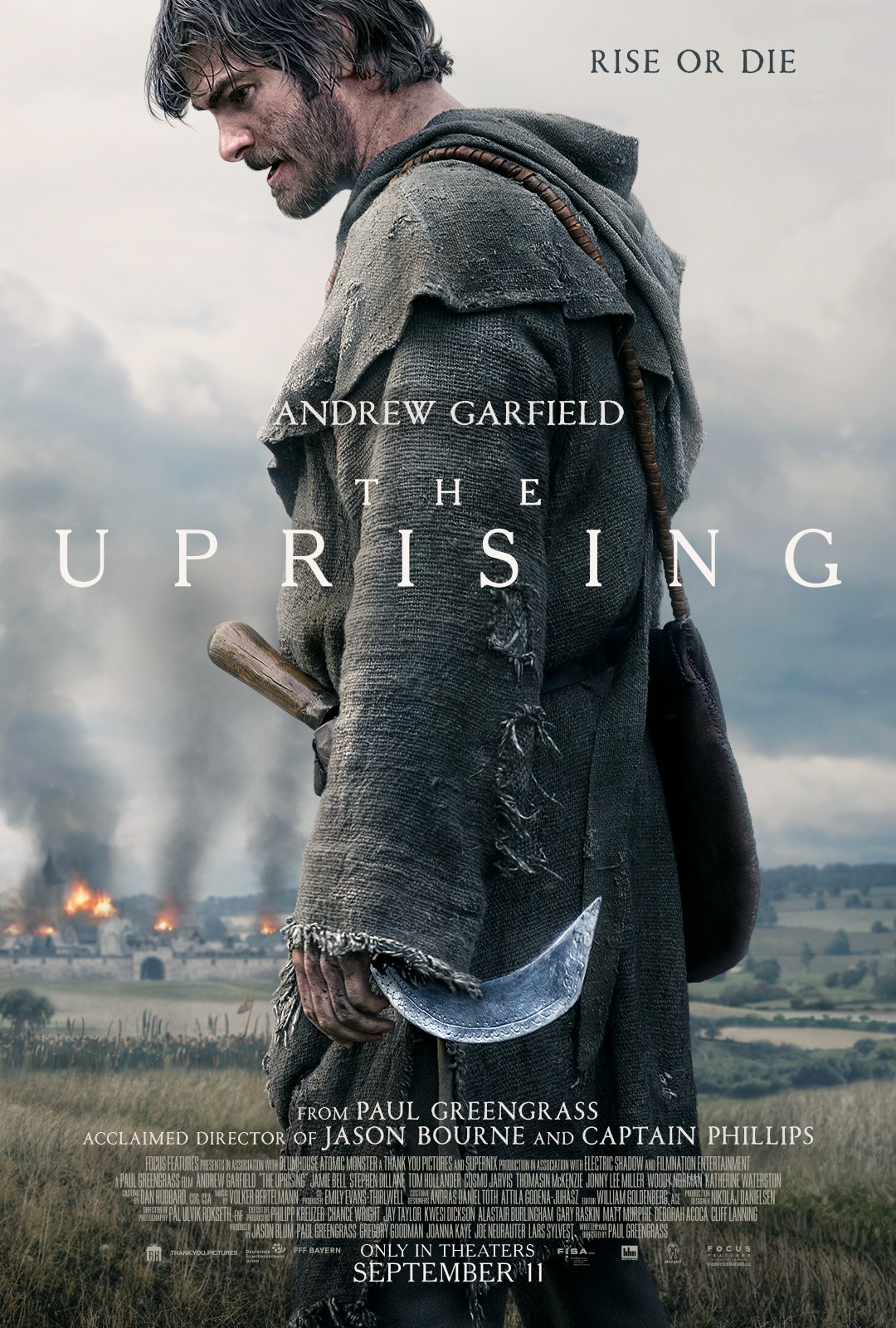
The Uprising is a historical dramatization of the Peasant’s Revolt of 1381. The Peasant’s Revolt was a response to unfair taxation and poor treatment of serfs in England, resulting in a riot and a march on the capital to try to beseech the king at the time, 14-year-old Richard II. Richard was young, naive, and arrogant. He was manipulated freely by his council, later developing a God complex and becoming tyrannical.
Across the film, thousands of peasants carry out this revolt in what seems like only a few days. In reality, many more members of the middle and upper class were also involved, spurred on by general discontent, as well as fear of retaliation if they refused.
During the revolt, a great deal of violence was inflicted upon innocent citizens in reprisal for unrelated grievances; predictably, things got out of hand. When all the dust settled, the retaliation by the Crown was brutal, and the immediate goals of the revolutionists were met with abject failure; however, there were significant reverberations through the socioeconomic fabric of society, reforming tax laws and creating massive cracks in the feudal system due to landowners being fearful of another revolt.
The film stars Andrew Garfield as a fictional and unnamed ploughman who leads the rebellion. Garfield gives an honest and impassioned performance in keeping with his theatre background, and while his acting is decent, it’s weakened by the general blandness of the character. Meant to represent the noble everyman, Ploughman is depicted as the main driving force behind the revolt, but, like every other character in the film, no time is taken to establish who he is as a real person. He’s just a cardboard cut-out.
This is what makes The Uprising so wearisome. Director Paul Greengrass appears to prioritize historical accuracy by hitting key points within the timeline, but with only two hours to depict a months-long tale, there’s no room for any actual story. The result is two hours of non-stop fighting. Thousands of nameless extras slaughtering each other. The film lacks any sense of pacing, and has no character development.
During the movie, I couldn’t help but think of Braveheart, which also follows an uprising of lower class against tyrannical royalty. The key difference is that Braveheart was well-written and well-produced, and is a rich, entertaining story full of character dynamics and emotion. While many may decry its historical inaccuracies, I would rather watch an inaccurate dramatization than a blandly accurate depiction, which forgets that the truly interesting stories behind any historical event are born out of the surrounding context and human relationships, which usually come to boil long before the primary incursion.
The Uprising may have been better realized as a 10-hour miniseries, taking the time to establish context, characters, and backstories as the driving force behind the plot, while the actual revolt spans the final two episodes as a fitting climax to a rich story.
Unfortunately, Greengrass seems to think that turning the climax into the entire film makes for an entertaining movie.
It does not.