
This semester, I became a cautionary tale: six classes, two jobs, zero room to breathe. And I don’t say this to garner pity, but rather to offer you some insight into an experience that has been exhausting, boundary-pushing, and should never be repeated again. In other words, I say this to warn you. Because it’s easy to dismiss your present needs when you’re caught up in the prospect of a future payoff that isn’t even promised, actively sacrificing your sanity in the process.
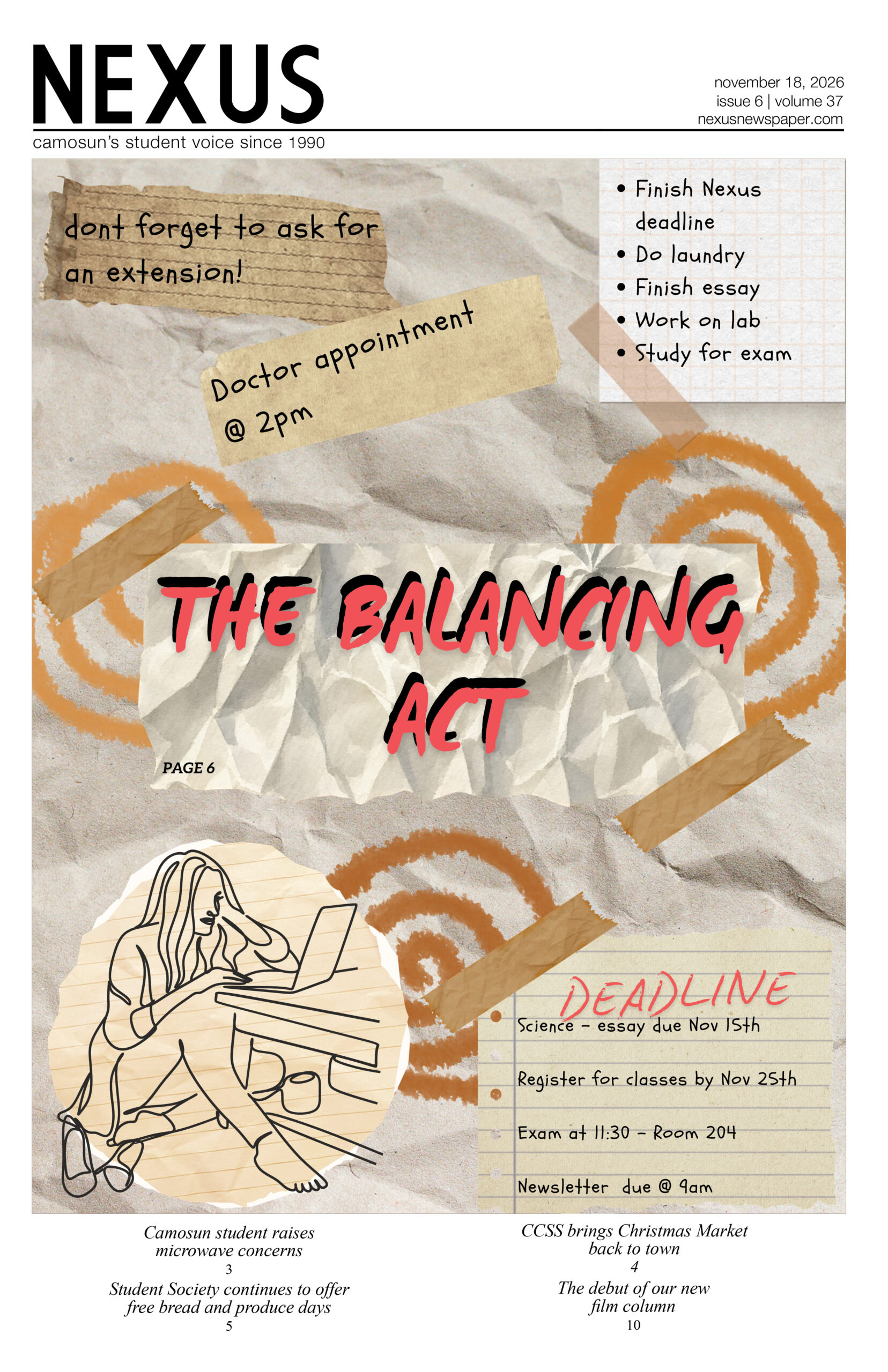
I think, as students, we’re pretty well accustomed to living our lives in the future tense, constantly obsessing over the next deadline, exam, or assignment. And in turn, staying present becomes nearly impossible. It seems like every immediate obligation is screaming for your full attention, draining what little cognitive energy you have left. And yeah, I’m sure some people can deal with this just fine, but I, for better or for worse, am certainly not one of them.
Until now, balance has always been a non-negotiable for me. I knew from experience that if I wanted to avoid burnout, then I had to ensure that my life was in no way consumed entirely by school. But this time around, that balance evaporated, and eventually my body stopped asking for rest and started demanding it.
For months, basic human functions became monumental difficulties. I struggled to fall asleep, and even more so to wake up. Over time, it got harder to focus, harder to move my body in a way that felt natural. But what could I do but keep showing up? It wasn’t a fear of failure that kept me coming back; that’s a pretty unavoidable part of life. Instead, it was this stubborn refusal to clear my plate because I’d made commitments, and ultimately the stakes felt way too high to just abandon them.
As a first-generation college student, I’m proud to be here, but that pride carries a lot of weight. And while I am allowed to fail, yes, I’m not allowed to stop showing up. But what I failed to realize earlier is that “showing up” means a whole lot more than just having perfect attendance and submitting assignments on time. Showing up also means taking care of yourself, even if you have to enforce it.
Now, I’m not advocating for you to skip class or start ignoring deadlines on a whim. But sometimes there’s nothing wrong with missing a lecture or two to catch up on sleep or going out with friends instead of starting that assignment. Because, ultimately, if you’re suffering from burnout and procrastination, the last thing you need is to be pushed further. The solution, I’ve found, is to take a big step back and recognize what’s really going on: your mind and body are begging for a break.
If you’re taking on a heavy workload like me, it’s crucial to accept that you cannot possibly give your all to every single class every single day, and learning how to balance that workload is key for both personal and academic survival. Believe me, I’m well aware that this advice can be brutal, especially for perfectionists. But part of life is learning how to let go, prioritize your obligations, and trust that the rest will shake out. Because I promise you, it will. All you need is a strategy, and the earlier, the better.
When you’re operating at maximum capacity, it can be devastating to feel like you’re falling short of one thing or another, but the sky won’t fall as a result. No matter how you slice it, the math just can’t add up. Sometimes, that five-percent assignment has to be sacrificed so you can ace your 25-percent midterm. You’re allowed to make that choice. In fact, you’ll have to someday, if you haven’t already.
My personal strategy has been to knock out the smaller tasks first. That way, once the busywork is done, nothing is hanging over my head. Then the bigger tasks come into focus. Your strategy might look nothing like this, and that’s fine. Because the fact of the matter is, even the best strategies will hit the wall sometimes. Life happens. You’ll get sick, a family emergency will come up, you’ll get called into work, or maybe you’ll just forget to set your alarm the night before. Nobody expects perfection from you, except for you.
Honestly, sometimes I envy the students who genuinely just do not care, who can coast by doing the bare minimum. I mean, what a luxury to possess that kind of detachment! Unfortunately, I care to a fault. Like, I’ve woken up in the middle of the night, running through equations and terminology before my eyes can even open. Some might call that anxiety… which might be worth looking into. In any case, it’s a pattern that I’m actively trying to break, because not only does it serve no purpose, but it’s eroding my health as well.
All this leads me to wonder what is actually worth the sacrifice. I mean, the last thing I want is to leave post-secondary as a shell of a human being who never learned how to delegate, set boundaries, or rest when I need it. I’d like to understand my own limits; what I need and what I don’t need.
With this semester’s schedule, my hobbies have pretty much completely vanished. And on the rare occasion that I do find a free moment, this incessant guilt creeps in, insisting that I have no business taking my eye off the prize, even just for a second. But what is the actual prize here? Chronic fatigue? Chart-topping cortisol levels? A generally unpleasant attitude?
Personally, I’m working toward a future defined by balance. While I do have career goals, I also have no intention of making my job the centre of my universe. So why, then, am I setting an academic standard that completely contradicts the life I want for myself? I mean, is sacrifice really necessary to achieve one’s dreams? Maybe. But sacrificing everything? That’s a bad bargain. Don’t get me wrong, I have every intention of getting where I’m going—wherever that may be—but not at any cost.
It’s important to remember that college is only a season, and it will soon be over. And while pushing yourself is healthy, going beyond your limits is not. Sure, nothing changes if nothing changes. But then what kind of change do you actually want for yourself? To be stressed out, bitter, and unrecognizable? Or simply at peace? Conduct yourself accordingly.
Without a clear idea of who you are, where you’re going, or what you’re doing here, you can easily become untethered, and thereby susceptible to winds that may carry you places you never wished to visit. As author Edward Abbey put it, “Growth for the sake of growth is the ideology of the cancer cell.” Without a determinate goal, you run the risk of spiralling into an endless cycle of self-improvement with no clear motivation as to why. What are you trying to get better for? What is actually driving you?
Me, I’ve always had a pretty clear idea of who I am and who I’d like to be. I’m a writer, a creative, and I possess an annoyingly sensitive soul. I see beauty and pain in absolutely everything, and I ruminate like nobody’s business, although I will be the first to tell you that that can become a highly destructive habit if you let it.
Suffice it to say, I was not built for accounting, health care, or engineering. I mean, of course, I have immense respect for those fields; they keep our world turning. But in a society composed of institutions and corporations, I think we tend to forget to also credit the things that make us want the world to keep turning. As Robin Williams put it in the 1989 film Dead Poets Society: “Poetry, beauty, romance, love, these are what we stay alive for.”
Unfortunately, institutional metrics have deemed that monetary value is the single most important factor in determining all other forms of value. So I guess it doesn’t really matter if you enjoy painting if painting doesn’t pay the bills. Now, as an English student, watching this unfold in real time has been particularly heartbreaking. Because the way I see it, a life without passion is no life at all.
This semester’s really driven that point home for me.
And this brings me to something that’s been on my mind quite a bit recently. Because of the seemingly endless onslaught of post-secondary budget cuts, I was unable to register for any classes related to my major, and as a result, my semester became an uninspiring cocktail of science, social science, and history—all wonderful things, mind you, just not really my things. That, coupled with an unforgiving work schedule, completely eradicated any ability I once had to relax or even enjoy my hobbies. And believe me, it took a toll.
This reality highlights a growing crisis in post-secondary education. Here at Camosun, a large portion of our student body is enrolled in the University Transfer program, aiming to finish their degrees at a different school, often high-profile institutions like UVic or UBC. And while I know many of us appreciate Camosun’s quaint atmosphere, I also think there’s a myth that choosing to transfer to a similarly small institution means getting an inferior education with fewer opportunities, which is very untrue.
But as deficits, program cuts, and staff layoffs continue to spike across the province, it isn’t multi-million-dollar research universities that suffer. Smaller, more accessible institutions are getting gutted, and Camosun is one example. We’re also seeing it at Vancouver Island University, University of the Fraser Valley, and Vancouver Community College. Langara College was hit particularly hard, with over 200 faculty members receiving layoff notices and departments being forced to slash their budgets by 25 percent. The more we dismiss these smaller institutions, the fewer options we’ll have. So if you’re planning on transferring, I strongly urge you to look closely at all your options before defaulting to a massive institution, even if that’s still what you end up choosing in the end.
Now, it would feel disingenuous for me to lecture you on stress management, sleep hygiene, or self care when I still struggle with those things immensely. And the timing doesn’t help either. The days are getting shorter and darker, and it’s incredibly difficult to find motivation when the world around you is blanketed by clouds and rain, the sun disappearing for weeks on end. It is bleak, and it is hard. Give yourself some grace for trying to continue.
Everything in the world, including us, is bound to a constant cycle of growth and decay. Seasons, we call those! Remember? They can shape our internal landscapes, as well as our external ones. I know I certainly move a little slower around this time of year. But in just over a month, we will reach the winter solstice; the shortest day of the year. And from then on, the world will get lighter and lighter, as will you.
Now, as we head into the home stretch of this semester, I want you to remember that it’s possible to keep going, even when it feels utterly exhausting. You are relying on you, which means you can’t afford to let the engine run dry. You have to be gentle with yourself. You have to do the next right thing, even if that thing is simply closing your laptop, pulling up the blankets, and taking a break.
While it’s necessary to look ahead, to get excited for what life has in store, and keep the bigger goals in your line of sight, it’s just as crucial to stay present. Because try as you might—and goodness knows I do—you cannot plan for what you do not know. The future holds endless possibilities, yes, but you can’t predict its exact trajectory. And that’s okay.
Sure, we can treat our plans like immutable blueprints, but in reality, I think they’re a lot closer to rough sketches. I mean, for over a year, I meticulously planned my university transfer so that I could one day complete my BA with a concentration in English Literature. Then one day in early October, that option disappeared completely, and, suddenly, the plan that I’d spent so much time working toward fell into a sinkhole.
So, what could I do? Well, exactly what I’ve always done, and exactly what every student navigating this volatile system must learn to do: keep going, find a new direction, and see where I land. Because what’s the alternative? Taking it on the chin and abandoning everything I’ve worked for? Curling up in defeat because the universe didn’t adhere to my clearly mapped-out plan? No. And honestly, that all-or-nothing mindset is going to hold you back.
Instead, you pivot. You adjust your vision of the future, accept that it’s infinitely susceptible to change, and you keep moving forward with the pieces you have left.
One day, this frantic scrambling won’t feel so terrifying, stressful, or upsetting. One day, the dust will settle, and it will just be your life—a good, somewhat unpredictable life. But in order to get there, you have to keep showing up however you can, in whatever capacity you have to give, and remember that this gruelling semester is only a season. It may be cold, rain-soaked, and dark right now, but eventually winter has to give up, and the sun will shine once again.
What I’m starting to realize is that the classes we stress over, the grades we kill ourselves to achieve, and the timelines we arbitrarily impose on ourselves are entirely secondary to the act of actually living. And when we take away the GPA requirements and the crushing weight of an unmanageable course load, all we’re really left with is ourselves and the things that make us feel alive—our favourite stories, our favourite memories, music that gives us an escape, and, most importantly, those fragile moments of genuine connection with the people who love us for exactly who we are, not what we can accomplish.
So, if you’re holed up in the library, buried under a stack of flash cards and wondering how you’re going to survive the next few weeks, I just want to remind you to look up and remember that there’s a world out there beyond the perimeter of this campus, and it is fundamentally indifferent to whether or not you get an A or a C on your next exam. I’m not telling you not to try, but I am encouraging you to detach from the outcome and just do your best. That’s all you can do.
As we finally approach the end of what’s more or less felt like an endless semester, I want you to hold on to that feeling of resilience, even if you can’t really recognize it right now. We are so close to the end, and you managed to get yourself here. That’s something to be proud of. All we can do now is take it day by day, one day at a time.
I’ll see you on the other side of the solstice.