
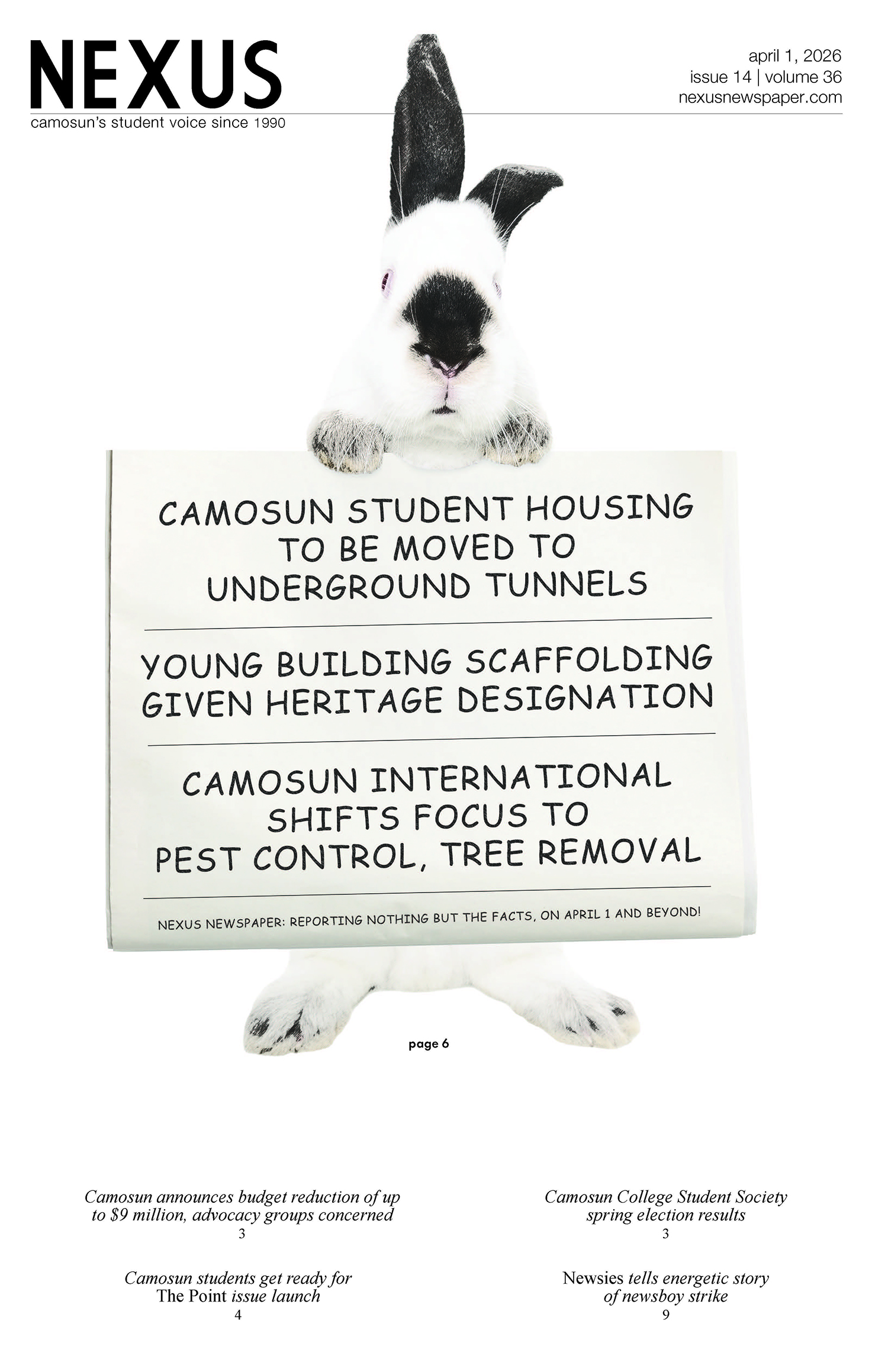
Student housing to be relocated to tunnels under buildings
The Lansdowne student housing project is finally set to break ground this spring, after years of planning and prepping. And as the dust begins to settle on the P6 parking lot, anticipation of what’s to come only grows. Some students are hoping to get a room for themselves, while others are simply looking ahead with hope for future Camosun students. All, however, are likely to be disappointed.
You see, over the past few years, various faculty members have voiced concerns about no longer being able to meet the cost of living here in Victoria. As a result, on April 1, Camosun College will be finalizing its decision to move this project in a different direction, shifting from student housing to instructor housing.
This change has been well-received amongst faculty. In fact, when asked about the displacement of future students, one instructor said, “Roommates build character. Kids need that nowadays.”
Despite this, the college itself seems to be rather aware of these concerns, as they’ve already begun drafting a new plan for student housing, which will be nestled in the underground tunnels between the Young Building and the Ewing Building. According to the college, this “central location” will make for the perfect student housing, complete with a “cozy, open-concept interior, perfect for communal living.”
And while there may not be any cell service or sunlight, the college has stressed that this new arrangement will get students to and from their classes much quicker, while also reducing their screen time, thus enabling them to focus more on their studies. (Although, oddly, the wi-fi is better down there than in many above-ground campus spots.)
This “win-win” scenario has been praised by faculty members for both its efficiency and its care. Apparently, they haven’t noticed anything wrong with living and working in the same square kilometre indefinitely. Or with displacing students. But you can take your pick as to which one is worse.
-Smashley Bagel, student editorial assistant
“Of course it wasn’t real”: BC government on post-secondary review
False alarm, everyone: the provincial government has released a formal apology regarding the much-talked-about independent post-secondary review and said it was all a big April Fool’s joke. A spokesperson from the post-secondary sector states that this was all a “big misunderstanding.”
“Of course it wasn’t real,” says the spokesperson. “That would be perfectly absurd if we only took four months to make such a massive decision. I mean, we already knew that we needed to invest more in this sector from the last review. Spending so much time, energy, and resources on that would be ridiculous.”
This joke had several student-advocacy organizations highly concerned for the future of post-secondary education in the province based on the government’s statement that there would be no additional funding given to the sector. Again, the government would like to assure students that all is well and they care about students’ futures.
“I mean, we don’t have nearly enough doctors, nurses, teachers, etc. All those jobs require a lot of schooling, so if we don’t give the sector more money then we just make the problem so much worse. What’s more important: the future of the province or balancing our budget?” the spokesperson said.
One reason listed for this review was that the cap on international students reduced how much students were spending on post-secondary. The province was quick to blame the federal government for that decision and was upset that this was now their mess to deal with.
“We lost a lot of income from the loss of international-student tuition, which sucks because we can increase their costs basically whenever we want. There was some consideration around increasing domestic student tuition but we wanted to keep it affordable and accessible to everybody,” states the spokesperson.
Students shouldn’t worry too much that their tuition might increase or their class options might be drastically reduced—it was all a joke, after all.
-Tasmine Flagstaff, student editorial assistant
Camosun International diversifies, mainly just to stay busy
With international student enrolment taking a nosedive due to ill-advised governmental decrees, staff at Camosun International have been left twiddling their thumbs. After initially enjoying their reduced workload, however, they began to fear that they may be seen as redundant and have their positions terminated. They quickly convened a think tank to figure out how to stay useful and avoid the axe.
A few intrepid International employees were seen suiting up in hazmat gear to tackle the ever-increasing silverfish population in the Richmond House bathrooms.
“It’s terrible,” mumbles one shell-shocked employee. “You kill one, but 10 more take its place. I see them whenever I close my eyes.”
Others have started acting as counsellors for members of the faculty amid budget-related fears of program cancellation.
“I have no idea what I’m doing,” says an anonymous Camosun International staffer turned would-be counsellor. “I’m sure that this must be illegal. I’m just repeating things I learned from One Flew Over the Cuckoo’s Nest. The faculty sure do cry a lot.”
“I’m actually pretty good at this,” says another employee trying her hand at counselling. “I just give them the advice my granny gave me: ‘Ain’t no problem in this big ol’ world what can’t be solved by whiskey!’ They seem much happier after a few shots in my office.”
A few enterprising Camosun International staff have also picked up chainsaws and are helping to eradicate those pesky Garry oak trees in what is left of the parking lot, in line with the college’s recent crusade to destroy the legally protected and beloved native tree.
“If we kill all the trees,” says one Camosun International employee through his balaclava, “we can build housing for the international students we can’t have!”
-Nike Stovetoss, student editor
Camosun exploring revenue-saving water possibilities
A secret pilot project operating at Camosun’s Lansdowne campus has returned favourable results, says Camosun chief financial officer Betty Hussler.
Students may have noticed over the past year that the lone water-bottle filling station in the Young Building has been inoperable. While this was presumed to be the result of a general lack of care for the student body, it was actually done intentionally to save money on utilities. The project was concocted by Hussler.
“Call it a happy accident! Drink sales from the bookstore skyrocketed,” says Hussler, “which wasn’t even on our evil bingo card!”
In order to make sure it wasn’t just a fluke, her departmental drones did some digging.
“We use facial recognition software in all our cameras around campus, for all kinds of reasons that are none of your business,” says Hussler, “and so I decided to see which students were causing the uptick in sweet, sweet profit. It turned out that the students responsible for nudging my Christmas bonus up were on their way to the Young Building.”
So, when Hussler met with college president Zane Cotter, a plan was quickly formulated to capitalize on this unexpected turn of events.
“We would shut down every bottle-filling station on campus, and then we could all get huge bonuses,” says Cotter, “but stupid Legal said we couldn’t do that without there being some backlash, and the students scare me.”
But Cotter and Hussler had a brainstorming session and came up with an idea that would keep Legal happy and still avoid making hydration convenient and free for students.
“We decided to let them use the big, dirty fountain!” Hussler and Cotter say in unison. “You know, that big one that’s in the shape of a letter C?” says Cotter. “Hey, I think it’s a ‘C’ for Cotter!”
-Nike Stovetoss, student editor
Young Building scaffolding to receive heritage designation
The original construction of the Young Building took roughly three years to complete, with its doors opening for the very first time in 1915. What started as a humble teacher’s college was swiftly converted into a military hospital during World War II, giving cause for the building’s eventual heritage designation some six decades after its construction.
With historical and architectural significance, it only stood to reason that this building should be properly honoured for its brilliant craftsmanship and years of servitude. The building underwent its second round of renovations in early 2016, due to growing safety concerns and structural deterioration. And now, 10 years later, those renovations are still ongoing.
Because of this, the Young Building has been encased in scaffolding for over a decade. This permanent addition has not only impeded the lives of late-running students for roughly 30 semesters, but it has also caught the attention of Saanich Heritage.
With one-tenth of the building’s lifespan spent surrounded by an under-utilized jungle gym, Saanich Heritage has elected to extend the building’s heritage designation to the scaffolding itself, citing its “significant contributions to this historical community space.”
The foundation released a statement in defence of their decision in mid-March, claiming the scaffolding “enhances the building’s heritage by drawing attention to the inefficient practices of contractors throughout time and eras.”
In fact, there’s been widespread speculation that the reason these renovations have taken so long is that the workers have been instructed to use only historically accurate tools and techniques. We reached out to the college, as well as the construction company, but did not hear back by press time as they were using a time-appropriate carrier pigeon to respond.
Rather than providing a plaque, Saanich Heritage has donated four new scaffoldings to be placed around various entrances to the Young Building. The date of their installation has yet to be announced.
-Smashley Bagel, student editorial assistant
Province announces Make Those Stupid Kids Pay for It initiative
With British Columbia smashing through the previous record for highest deficit in its history, sitting at a $13.3-billion fiscal gap, our provincial government has tabled a budget strategy to address this shortcoming.
BC premier Davey Bye and finance minister/party girl Kelly Kahlua made a joint statement about one of the main focuses of the new budget plan, announced in the ballroom of the luxe Hotel Vancouver to the Board of Trade, who had gathered for a mimosa-heavy breakfast event held on February 20.
“We are calling it the Make Those Stupid Kids Pay for It initiative,” said Bye, “and I think it’s going to be very popular amongst the members of the public who actually go vote. Basically, we are going to jack up tuition all over the province, as well as some super sneaky stuff that those smoked-out college dopes won’t even notice until way later.”
Kahlua, the architect behind this plan, explained how this amelioration will work to an already cheering crowd of white hair and loose skin.
“What we’ve done, now get this, guys, what we’ve done is something those idiot kids won’t even notice for, like, another 10 years. We’ve put a clause into the StudentAid BC terms and conditions—we all know they don’t read those—that says if their loans aren’t paid in full within the first year after college, then the interest rates go sky high!” she said to the horde, which smelled of medicated ointment and soiled Depends.
“We haven’t even stipulated exactly how sky high, so we can make them pay, like, you know, whatever we want!” Kahlua said to the cheering crowd. “Irish coffees all around!”
-Nike Stovetoss, student editor
Camosun to start charging for absolutely everything
Camosun College recently announced that due to a decrease in revenue, there will be a dramatic increase in the cost of everything.
Textbooks, even the cheap printed course packs that Camosun makes, will start at $200 and all recommended books for a course will now be a mandatory purchase.
The food on campus will simultaneously double in price and shrink in portion size, resulting in minimal satisfaction but maximum profit. Interurban will no longer have more interesting choices—both campuses will have the exact same options available.
The college also announced it will start charging for previously free amenities to make up for the revenue decrease. Solo library study spots will need to be booked in advance, with a fee of $10 an hour. Study rooms will cost the same, but charges will vary based on the maximum capacity of the room. For example, a three-person room would be $30 for an hour and a 10-person room would be $100. This price will double in the weeks leading up to finals.
Classes will continue to be cut to avoid any duplicates, leaving only one or two sections available per course. Hopefully you’re fond of 8:30 am or 6:00 pm start times, because that’s all that’s available for your required English credit. There will also be fewer program-specific courses like Anatomy for Nursing; they can just take regular anatomy classes since they sound like basically the same class anyways. The college just can’t afford any doubles like that.
A college spokesperson said that these financial decisions may seem extreme, but they were made with the best interest of students and faculty alike in mind. Budget cuts need to be made somewhere, and it’s only going to impact students’ course fees, campus meal options, study spaces, and section and course options.
-Tasmine Flagstaff, student editorial assistant
College fully embraces AI, everything falls apart for some reason
In response to its 2026-27 budget, which featured a multi-million-dollar deficit, Camosun College has chosen to implement AI on a mass scale. With instructors getting laid off and onboarding now at a standstill, the college claims that the utilization of AI is not only reasonable, but “the only logical direction” to go in.
It’s unclear exactly what the college plans to do with this program, the name of which has yet to be disclosed; however, there have been early talks about digital outreach, as well as a number of AI-led media courses. Presently, they are nearing the end of a trial period with the program, testing its limits and figuring out how it can best suit Camosun’s needs, then going from there.
The first task this program was given was to work on the Camosun’s Future webpage, expressing a commitment to providing student support and enabling their success. The site has since gone dark, with no explanation given from the college. Several instructors who have previously voiced optimism around the usage of AI have declined to comment on the issue at this time.
Simultaneously, various water fountains across campus have mysteriously dried up completely, leaving students to rely on barely functional vending machines to get them through their day. Some instructors have even suddenly taken to conserving energy in the classroom, although none have expressly stated why. Students in evening classes have voiced concern over not being able to see the board, their notes, or anything around them, for that matter.
Despite growing concerns, the college remains persistent in its refusal to address the issue head-on, or even halfway-on. However, some students have reported noticing additional locks on various doors throughout the Paul Building and the Isabel Dawson Building. Strange.
-Smashley Bagel, student editorial assistant