
In Greek mythology, the tale of Orpheus and Eurydice is a classic tragedy of conflicting desires. The story is simple: Eurydice falls ill and dies, and her lover Orpheus is beside himself with grief. He travels to the underworld to beseech Hades to return her to him. Hades agrees, on the single condition that Orpheus is not allowed to look at her until they return to the surface.
Initially, he follows this rule, however, Eurydice, who is not aware of the limitation, believes he is ignoring her out of disgust. Heartbroken, she refuses to follow him, saying she is as good as dead without his gaze. Orpheus breaks, but the moment he looks upon her, she dies, for Orpheus has broken his promise.
This simple tale, like all Greek mythos, defies logic or reason. Certainly it would have been easy for Orpheus to tell Eurydice about his promise. Yet, this failure to communicate is a commentary on human nature: caught up in our desires and personal torment, we fail to see what is right in front of us. We refuse to speak in plain terms to those closest to us, and it tears us apart.
Performed at the Royal Theatre from April 22 to 29, Pacific Opera Victoria’s Orpheus & Eurydice features dancers from Ballet Victoria, a score from Victoria Symphony, and vocals by Pacific Opera Chorus & Supernumeraries. Orpheus and Eurydice are played by Christian Sanders and Andriana Chuchman, respectively, and Amore (the messenger from Hades) is played by Suzanne Rigden.
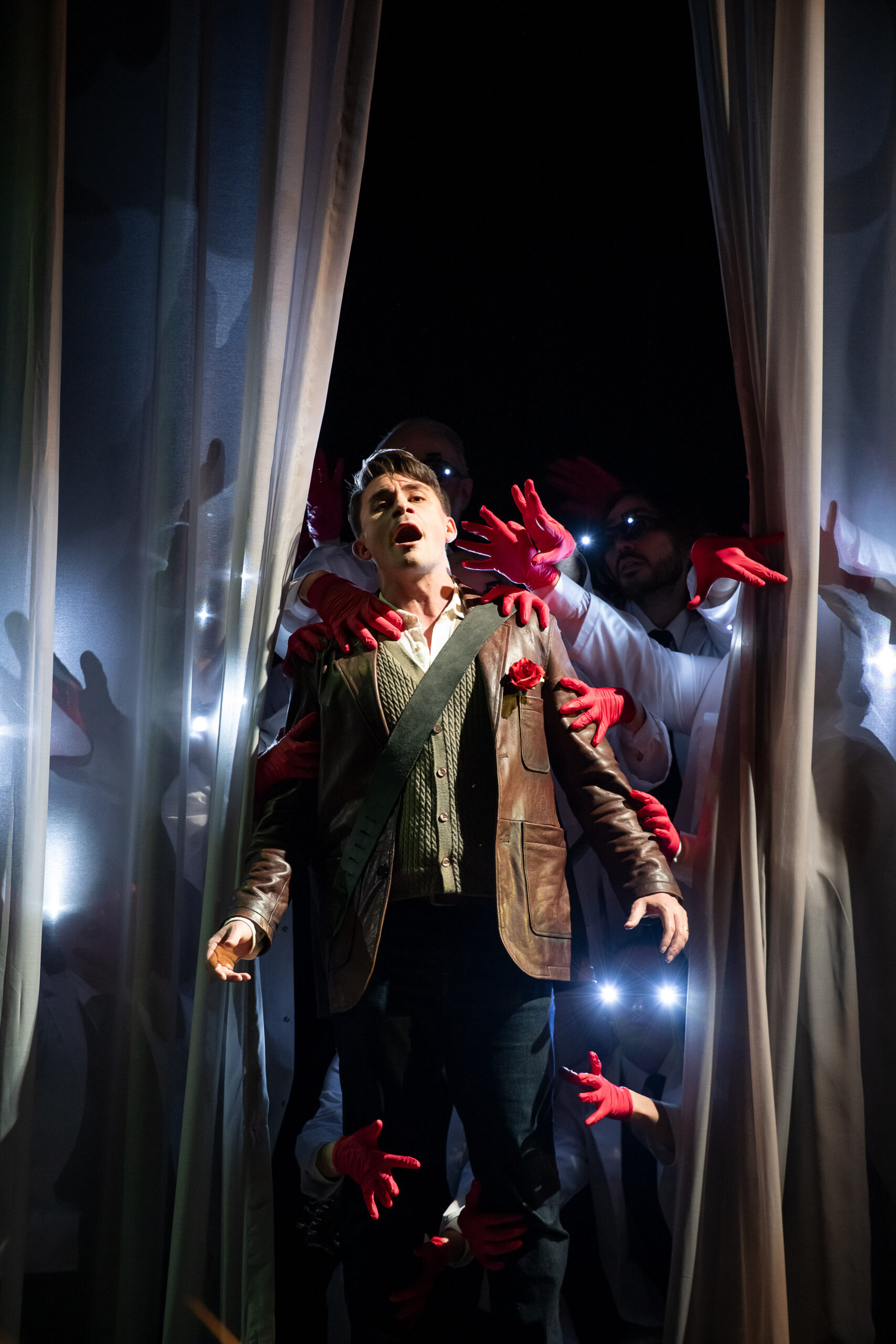
An impressive feature of the show is its use of visual storytelling. The prologue opens within a modern hospital room, where Eurydice is dying with Orpheus by her side. Without dialogue, we see that Eurydice is sick; her nurse offers her morphine, which she initially refuses but later succumbs to pain and changes her mind, clinging to Orpheus. In her last moments of delirium, she sees a hallucination happen before her, wherein the classic Greek tragedy unfolds.
The set uses creative interpretation and abstract design to portray the locales of the underworld, including some pleasing work with translucent curtains and silhouette to create the ghastly, ghostly figments of the Furies of the Underworld, who initially threaten to pull Orpheus into the depths of hell but are charmed by his story and allow him to pass.
As far as the performance goes, it’s heavily carried by Sanders, who has the vast majority of lines in the two-hour production. Fortunately, he is excellent at his craft, singing with boldness and powerful resonance for long stretches, with one solo nearing 40 minutes of continuous song. How he can sustain such power for so long without destroying his voice is beyond me; it was the most impressive part of the show. The performances from Chuchman and Rigden were equally well done, and the accompaniment by the orchestra and the ballet dancers was beautiful to listen to and delightful to watch.
Based on the 1762 libretto by Ranieri de’ Calzabigi, the script is entirely in Italian. It’s presented as dramatic, flowery poetry, and can lead to audience fatigue, as Orpheus at times comes across as an insufferable melodramatic who loves to hear his own voice. This was the status quo for many operas of the time, which take far too many words to portray a simple story. Classic, but wearisome.
Pacific Opera Victoria’s Orpheus & Eurydice is well produced and well performed, and, despite being a little longer than the simple story demands, is a delight for opera fans.