
A requiem is a religious ceremony or song composed to honour the deceased. In 1866, when legendary composer Johannes Brahms was 33, he started seriously writing Ein Deutsches Requiem, which he intended to write not as an expression of mourning, but a requiem for the living, to provide comfort.
On Sunday, May 24, the Victoria Choral Society (VCS) presented Renewal, a performance of Brahms’ Requiem, as well as Marble of the West, a modern piece composed by Iman Habibi, conducted by VCS artistic director Brian Wismath and featuring the soloist talents of soprano Jennifer Turner and baritone Nathan McDonald.
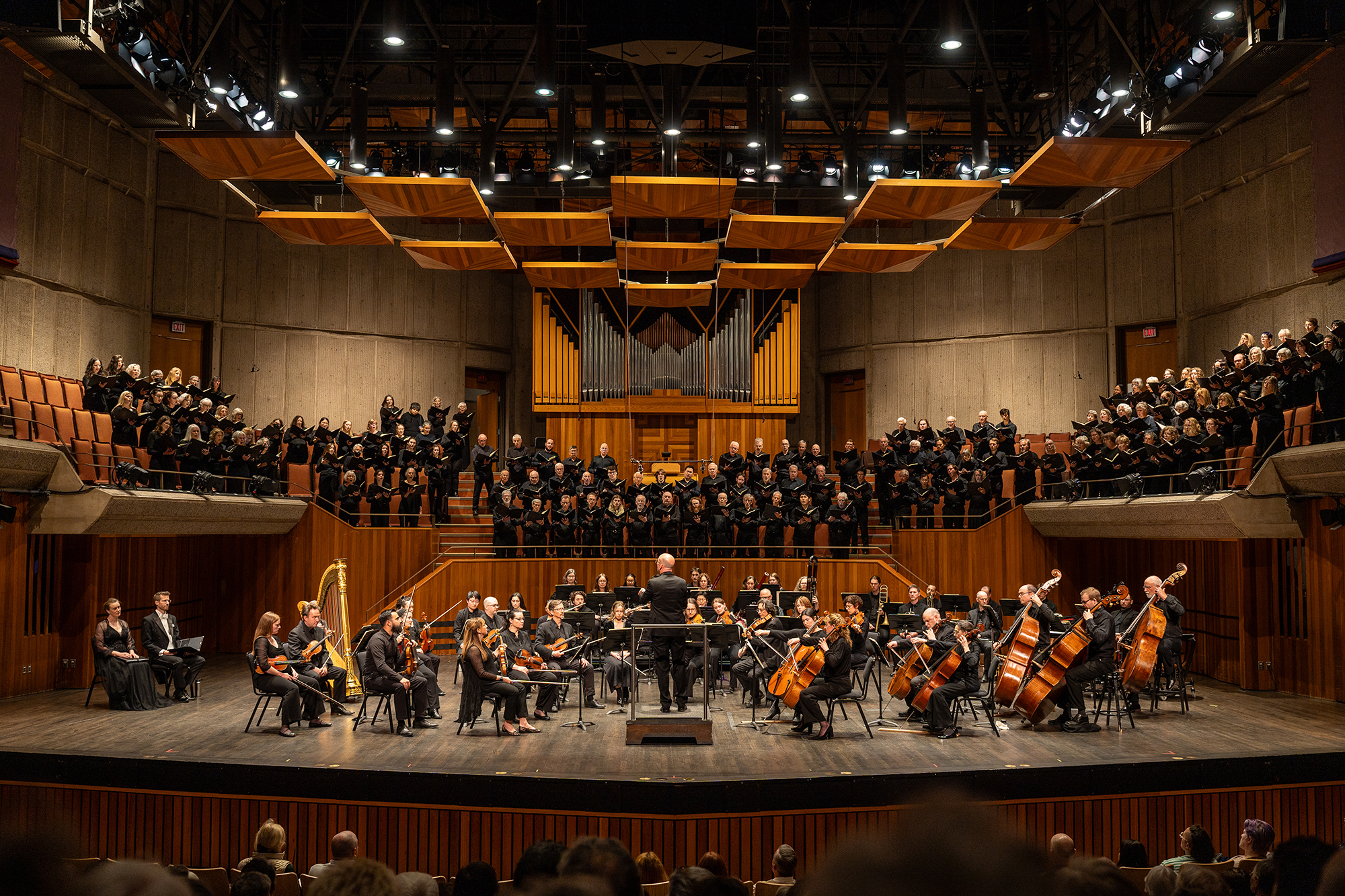
As a professional production, Renewal was competently arranged, conducted, and performed, showcasing the talents of about 50 orchestral artists and around 140 choral performers, and creating a stirring auditory landscape in UVic’s Farquhar Auditorium.
However, I found that I enjoyed this show less than others I’ve seen from VCS, and the reason has to do, in part, with its scale. For me, the most compelling part about live music is observing the musicians, and discerning how their performances come together to create the music on offer. As listeners, we’re used to a piece of music existing as a whole, without the opportunity to see the magic unfold before us.
Live music gives people an opportunity to disassemble the score as they’re listening to it, identifying individual instruments or voices from the musicians and bearing witness to the expression of talent and skill in real time. In Renewal, this concept was adeptly illustrated by the solo performances of Turner and McDonald, whose striking voices rang clear and powerful throughout the space, and, for me, were the highlight of the afternoon.
Yet when it comes to productions that employ an army of choral performers, individual sounds and voices become indiscernible, and what we are left with is a heavy wall of sound leaning upon the audience. In sublime cases, the vocal control of dozens or even hundreds of choral members can harmonize in a way where the whole is greater than the sum of its parts, eliciting the sort of visceral awe that sends a shiver down the spine, but this is a difficult task. If done poorly, it results in an aggregation of voices that takes on the characteristics of a crowd of people all talking at once, rather than exquisite vocal choreography.
Victoria Choral Society did not exactly do a poor job in its performance of Renewal, which could be considered objectively decent, but try as I might, I could not lose myself in the magic that I so often cherish about live music. The performance didn’t come together as I had hoped, and I found myself leaving disappointed. Perhaps Renewal was a requiem of stronger performances of the past.