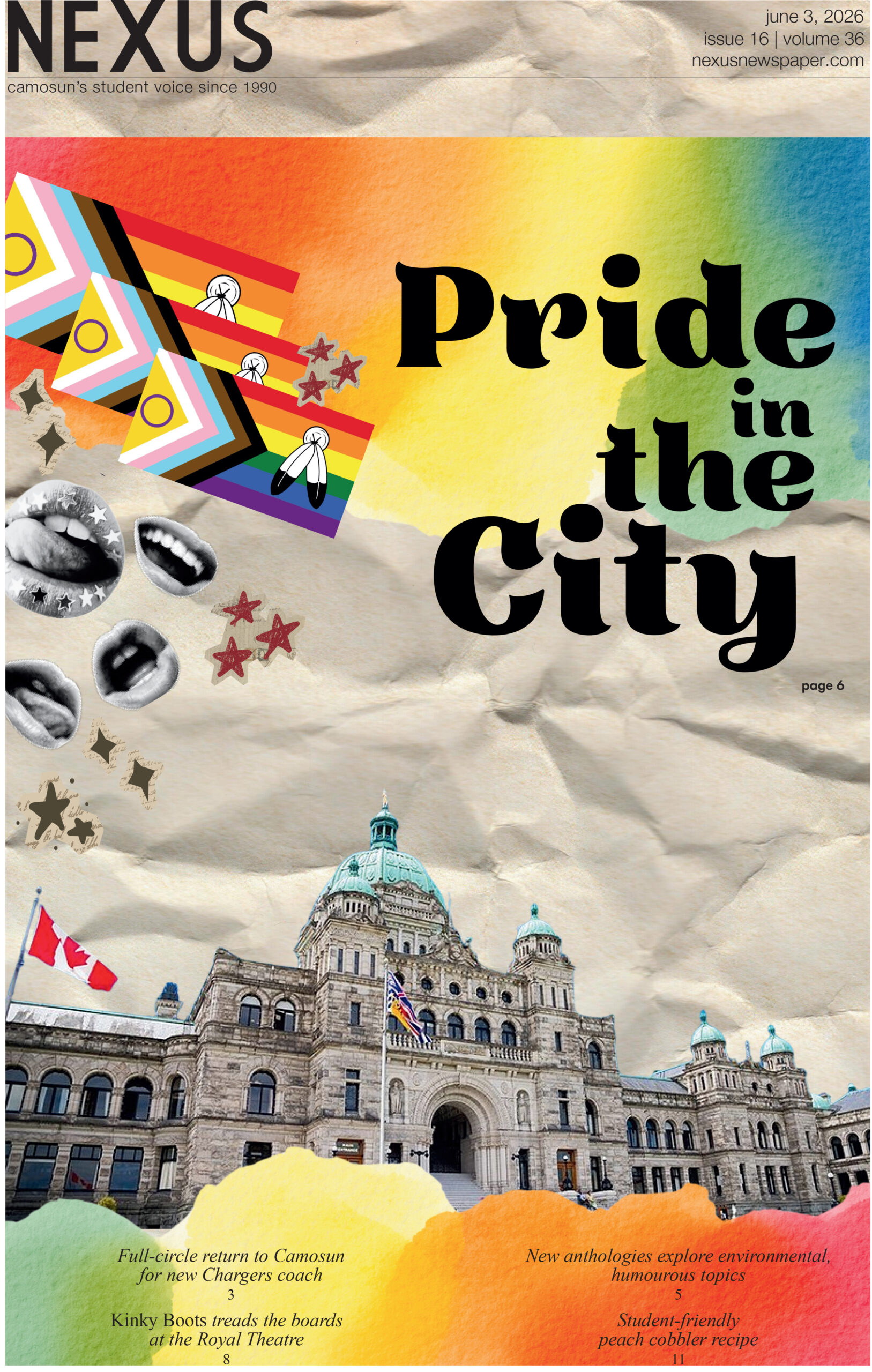
Every year, in the month of June, millions of people from around the world come together to celebrate Pride and honour the ongoing liberation of the 2SLGBTQ+ community. In Victoria, this will mark the 33rd annual celebration, complete with a community dog walk, a baseball game, and, of course, a parade. But the origins of Pride in Victoria actually date back quite a bit further than this. So, wash out that perm, throw on your favourite power suit, and let’s head back to 1981, when Pierre Trudeau was serving his second term as Prime Minister of Canada, and the radio wouldn’t stop cycling between Air Supply, Neil Diamond, and Rick Springfield.
By this point, homosexuality had been decriminalized in Canada for well over a decade. In fact, the very amendment responsible for this change was passed in the House of Commons just before the Stonewall Riots in New York City. Don’t know what the Stonewall Riots are? Let’s go back a little bit further.
On a midsummer evening in 1969, police raided the Stonewall Inn in Greenwich Village, a well-known social space amongst members of the 2SLGBTQ+ community. Now, this wasn’t anything out of the ordinary. In fact, at the time, in every state other than Illinois, bars and restaurants ran the risk of being shut down if they were to knowingly serve gay patrons or, God forbid, employ gay workers. So, how did they manage?
Well, for starters, the bar itself was owned by Tony Lauria, a young member of the Genovese Family, one of the Five Families of the American Mafia, who dominated organized crime in and around New York City. Still do, in fact.
Interestingly enough, throughout the ’60s, the majority of gay bars in Greenwich Village were owned and operated by the Genovese Family. Now, were they doing this to create positive social change? Not exactly. The truth of the matter is that the gay community was an untapped goldmine in those days, and while most establishments refused to serve them, the Genovese Family saw a mutually beneficial opportunity and took it, with Lauria even making regular payments to New York’s Sixth Precinct to look the other way. Yes, it’s true, monetary persuasion was a pretty big thing in the ’60s. And the ’70s, and the ’80s, and the ’90s, and, well, you get it. But we’ll circle back to this.
So, that night in 1969, inside the Stonewall Inn, folks were dancing, mingling, and drinking when the NYPD suddenly stormed in. It was a Friday night at peak hours, and, unusually, the business hadn’t received any warning prior to the raid. Patrons were caught dancing and flirting with members of the same sex, with some of them even crossdressing. The police, of course, responded with violence. Only, this time, the patrons fought back, and a riot ensued.
This was by no means the first instance of 2SLGBTQ+ individuals defending themselves against brutality and persecution, but it was a turning point. Exactly one year later, on June 28, 1970, the Christopher Street Liberation Day Committee held the first Pride March in Greenwich Village, commemorating the Stonewall Riots while also kicking off the city’s first-ever Pride Week. Los Angeles and San Francisco followed suit, as did Canada, Australia, Germany, France, and others.
Now let’s head back to 1981, when Victoria held its first-ever Pride Week. By all accounts, it was a pretty low-key affair, especially considering the mayor at the time had refused to even recognize it, claiming it was too “inappropriate.” But even still, the week had been full of community events, and ended on June 28 with the Stonewall Tea Dance.
The following year, Victoria saw its second Pride Week, but the celebrations were halted shortly thereafter due to concern over the AIDS epidemic. With extremely high mortality rates, and an effective treatment not being discovered until 1987, the death toll continued to rise. With each day that passed, more and more gay men were refused medical care due to extreme levels of ignorance surrounding the disease, prompting a great number of lesbians to step up and fill those roles.
Working closely with blood banks to ensure that their blood went straight to AIDS patients, these women managed to fill critical shortages when gay men were disallowed from donating blood themselves. In addition, they regularly assumed the role of grief counsellors and would offer companionship to those in hospice as they were dying.
This is why the 2SLGBTQ+ acronym looks the way it does. “Lesbian” is before “gay” as a means of paying tribute to the love, leadership, and support they gave to their community throughout the AIDS epidemic.
Nearly a decade later, as things started settling down, Victoria resumed its Pride celebrations in 1991 with a picnic in Beacon Hill Park, and despite the two Pride Weeks held in the early 1980s, many consider this to be the true beginning of Pride in Victoria. Roughly 200 people gathered around for some barbecue and great company, and before they knew it, it had become a tradition.
Not only that, but this humble event even managed to pave the way for the city’s first-ever Pride Parade in 1994, when hundreds of people took to the streets—or, rather, the sidewalks—to celebrate gay pride and demand visibility. Why the sidewalk? Well, simply put, they just couldn’t get the right permit.
Even still, they made the most of it, marching from City Hall to the Parliament Buildings. And, to their surprise, the display was actually fairly well received, prompting local shopkeepers to line the streets and cheer as a handful of drag queens put on a show.
And three decades later, here we are. What started as a couple of hundred people marching down a sidewalk has since grown into a full-scale event attracting nearly 70,000 people.
Now, it’s important to mention the work of the Victoria Pride Society, a non-profit organization that provides support for the city’s 2SLGBTQ+ community while mitigating oppression and making the city a better place to live for everyone. Established in 2005, they’re also responsible for organizing the Pride Parade, Pride Festival, and a number of other events that we’ll talk about later. But first, I’d like to reflect on something.
So, Pride has always been a complicated subject, right? I mean, the whole point is to build community, confidence, and promote self-expression. Sounds terrible, I know. Just walk with me for a moment.
I think it’s fair to say that some things have gotten better, but there’s still so much we need to be cognizant of. In recent years, a wide range of identities have been rightfully recognized, although not all of them stand alike. As it goes, everyone has different views and opinions on the way they think the world should work, even those belonging to the same community, because, despite our commonality, no two people are exactly the same. However, in light of this, finding that degree of separation has become noticeably more difficult.
With the origins of Pride largely stemming from police brutality against the gay community—specifically queer, gender non-conforming, and racialized individuals—many parade-goers have been left with a sour taste in their mouths when they notice a visible police presence at the event. Some have even taken to boycotting altogether.
Victoria Pride Society has noted this and aims to hire as many traffic personnel as possible so as to keep that police presence to an absolute minimum. Additionally, while this year’s parade will feature participants from the Canadian Armed Forces, officers will not be permitted to march in a military formation or carry weapons of any kind.
While this feels like a step in the right direction, there’s no doubt in my mind that everyone’s going to feel a little bit differently about it. Honestly, I think that’s to be expected because, at its core, Pride is political, having begun as a protest against the criminalization of 2SLGBTQ+ individuals. And in these circumstances, it can be hard to figure out where lines cross and where lines end.
My take is that as long as morality—a markedly undecided concept—is lumped under the same umbrella as legality, we’re probably always going to be at odds to some degree. And why is that? Well, because people are always going to take issue with those who don’t fit their perfect image of the perfect person, even if you seem to have everything else in common. And I think that’s part of the reason why Pride is so important. It’s good practice, showing kindness to others. Especially in today’s world.
Canada has come a long way and, in 2016, solidified a sharp legislative contrast to the United States by federally recognizing the Pride flag and raising it on Parliament Hill. Now, despite being the birthplace of modern Pride, the United States has yet to match this endorsement, and, honestly, I wouldn’t expect it to any time soon. But, hey, that’s just one more reason why we keep showing up.
It’s not enough to boast about social activism if there’s nothing to back up the things that you say. Of course, we can’t police intention, and there is value in visibility, but if that visibility gets revoked at the end of the month, as it so often does, then where do we go from there?
The Mafia wasn’t pioneering gay bars so people would think of them as some far-left, grassroots operation. They were pioneering gay bars because they wanted to turn a profit and solidify their control, which they more or less succeeded in doing. It just so happens that, in the process, they helped to liberate an entire group of people and paved the way for some real, positive social change around the world. So it kind of balances out, doesn’t it?
Now, in today’s day and age, we have an endless onslaught of predatory corporations that fill their storefronts with colourful imagery and half-baked slogans— but only for the month of June, of course—all the while actively engaging in unethical business practices, as if the Pride movement wasn’t built on a desire for fair treatment and equality for all (that would just be silly).
But, of course, like clockwork, these companies band together and parade themselves around like they’re some progressive, politically conscious entity that you should be putting your trust in, without actually giving you any real reason to trust them. And this is a pretty calculated move on their part.
You see, if every company says the same thing at the same time, then the backlash is naturally minimal. So, that’s what they do. They increase shareholder value while still retaining their usual clientele, and by the end of the month, they get to write off a huge success. It’s the classic Pride Month profit pit. But what about the rest of the year?
Well, the honest answer is that to risk a portion of your customer base by saying something that might be disagreeable is far too frightening a prospect for these corporations to even try. And why would they?
In circumstances like this, consistency is key. Because if these issues truly mattered to them the way they say they do, then they should be spotlighted all year, not just for one month.
Now, I’m not saying you shouldn’t buy that cute new sweater just because it’s June and somewhere some billionaire is making a profit off it. That’s true all the time! (Just maybe check the label to make sure you’re not paying for plastic.) What I am saying is that it’s important to remember that these corporations don’t value you or the community that you belong to. They care about the numbers. And you are so much more than a number.
For this reason, I think it’s a great idea to support your local businesses and charities instead. For example, The Coda just hosted a Queer Line Dancing night near the end of May, and Capital Ballroom is hosting a Pride Beach Party on Saturday, June 20. Oh, what’s that? You’re hoping for something a little bit smaller? Well, Paul Phillips Hall in Fernwood is hosting its Pride Eve Dance Party on Friday, June 19. Trust me, it’s a pretty quaint venue.
Saanich will be hosting its fifth annual Pride in the Park on Wednesday, June 17, so if you’d rather spend some time outdoors, there are options for you, too. In fact, there are a bunch of great Facebook groups, including Queer Outdoors, Queer Exchange Vancouver Island, and Creating Connections Victoria, to help you find your way.
Now, remember those Pride Society events I mentioned earlier? Let’s dive into those a little bit more. On Wednesday, July 1, Vic West Park will host the Memorial Drag Ball Game, where drag queens and drag kings compete in a friendly game of good old-fashioned baseball. This event dates back to the mid ’90s, when a group of friends—many of whom were drag performers—got together for a game of baseball in hopes that, even just for a few hours, they could forget about the hardships of their daily lives and just have fun. And it’s been a tradition ever since. Each year, more and more people show up, set aside their differences, and express themselves (rather theatrically, might I add).
Then, on Saturday, July 4, the Victoria Conference Centre will host Pride in the Word, a literary event showcasing 2SLGBTQ+ writers, authors, and speakers. And, quite frankly, if you’ve made it this far, you’re probably someone who enjoys reading. So, who knows? This might be right up your alley.
And, of course, the Big Gay Dog Walk will take place in Banfield Park on Wednesday, July 8. This event, which is a regular fan favourite, brings the community together to celebrate diversity and connection, and to vote in a bright, bashful dog costume contest. What more could you want?
On Sunday, July 12, the Pride Parade will march through downtown, followed by the Festival in the Park the same day in MacDonald Park, complete with activities, food, drinks (including a sober bar), and more than 100 local vendors for you to scope out.
Now, if you find yourself on campus with a little bit of time to spare, you can also check out the Pride Collective, a student-led organization that strives to cultivate a safe and welcoming environment for 2SLGBTQ+ students and their allies. In fact, if you’re on the Lansdowne Campus, you can even visit the Pride Lounge, located in room 103 of the Richmond House. It’s a great community space that’s open to everyone, and the only requirement is that you be respectful and considerate. Easy!
Now, before you run off to enjoy one of the many events we just chatted about, I want to leave you with this. Pageantry should always come second to progress, and as we move through the month of June, it’s important to pay attention to who is actually making that progress.
After all, Pride didn’t begin as a parade—it began as a riot.