Camosun Innovates has been recognized with a Land Award for its work on Totem 2.0, a project combining technology, sustainability, and Indigenous artistic traditions.
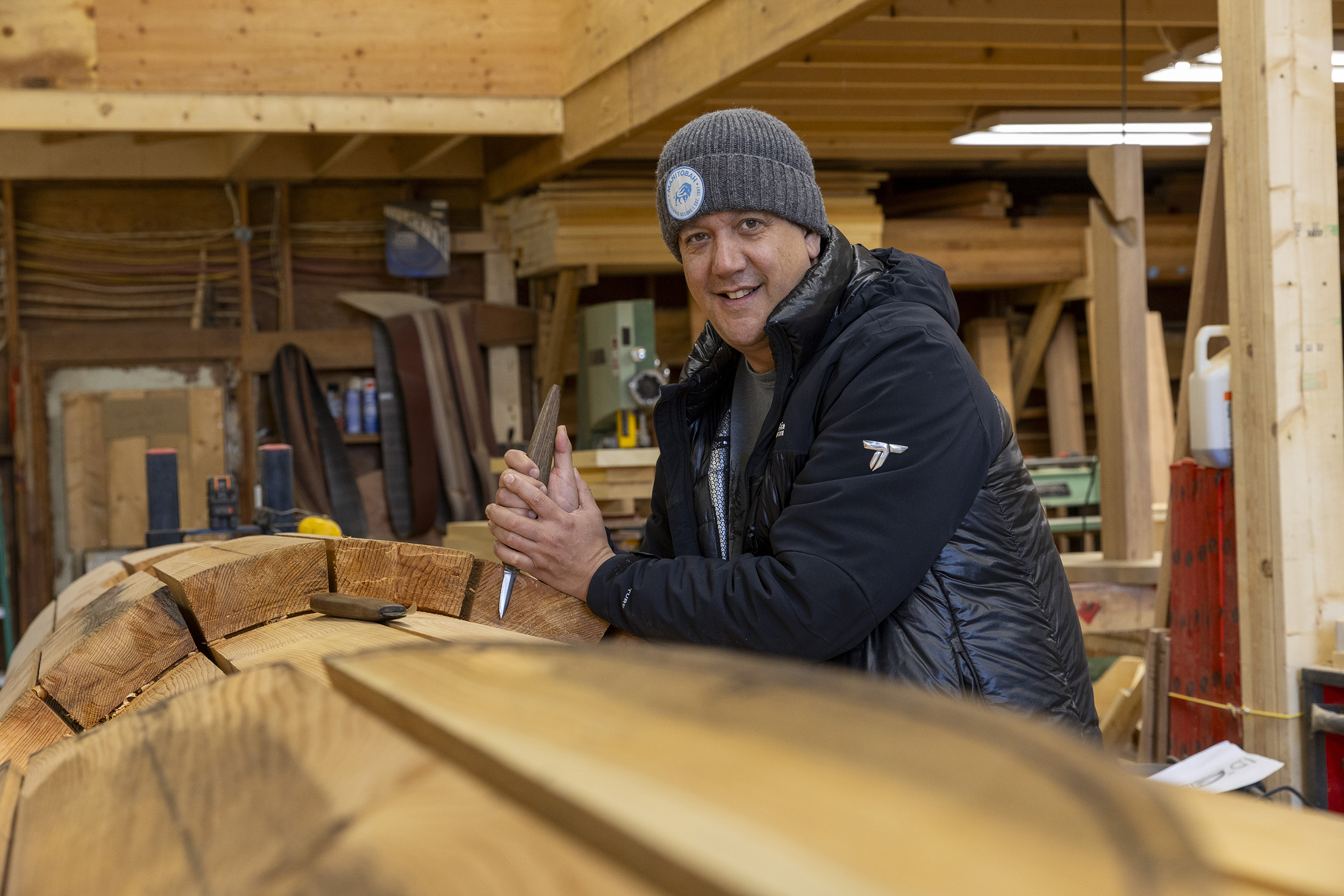
The project was developed in collaboration with Indigenous artist Carey Newman, a Kwakwaka’wakw and Coast Salish artist and University of Victoria impact chair for Indigenous art practice. Totem 2.0 explores how modern engineering and manufacturing technologies can support Indigenous artists while responding to environmental concerns around the availability of traditional materials.
Camosun Innovates director Richard Gale says that the college’s push toward supporting the Totem 2.0 initiative is a positive step for Camosun.
“This is a real commitment for the college, this kind of relationship building, and that we’re very proud to be at the forefront of this kind of work, and for Camosun as a college to be known for this kind of thing is absolutely remarkable,” he says.
The Land Award, given by the Real Estate Foundation of BC, recognizes projects that demonstrate leadership in sustainability and environmental responsibility. For Camosun Innovates, the recognition highlights the potential for applied research to address real-world challenges while supporting communities and cultural traditions.
“All of our work with First Nations has involved some level of sustainability, some connection to either revitalizing the land or understanding better how the land and its resources are being used or abused,” says Gale. “So it’s quite a remarkable thing to be selected for this award because we truly want to be the kind of place that supports sustainable futures and that is contributing to reconciliation and a deeper commitment to Indigenous partnerships.”
The project uses digital technology and advanced manufacturing techniques to help artists create large-scale carved works using second-growth cedar, rather than relying on increasingly scarce old-growth trees, preserving what remains for future generations.
“Carey came to us concerned about the ability of carvers to continue using old-growth cedar. There are fewer and fewer of the old-growth cedar available, and he wanted to find second-growth, new-growth cedar in the carving of ceremonial totems. And so he had this idea that there might be a way to make what was essentially a flatted totem, use new-growth cedar to create beams that could be put together to replicate, simulate an old-growth trunk.”
To facilitate carving with alternative wood, Gale says that logs must be cut and held in a particular, careful way, which is an issue without adequate tools.
“We created this mechanism to trim new-growth logs into the shape and the taper that would be necessary for carving,” he says. “And then we designed and built two carving, really, ‘rotisseries’ is the best way I can describe it, ways to secure multiple second-growth logs that had been made into beams that could be then kept together in a way that Carey could carve as he would carve on a traditional old-growth cedar log.”
The collaboration brings together Indigenous knowledge and artistic practice with Camosun Innovates’ experience with applied research, design, and manufacturing. The project seeks to demonstrate how technology can be used to support cultural practices while also addressing questions of sustainability and responsible resource use.
“It’s wonderful to be able to bring advanced manufacturing technologies and techniques into a realm where it can support Indigenization, where it can support creative practices that, you know, kind of need a new perspective and need new ideas. And just facilitating that for artists like Carey, it’s a true honour,” says Gale. “I come from an arts background, and so I’ve been really committed since taking this job to bridging that gap that often happens between creative arts and technology.”
The Totem 2.0 project builds on a broader relationship between Camosun Innovates and Newman, who has worked previously with the college on projects involving technology, Indigenous art, and cultural storytelling.
“We’ve been working with Carey for a very long time. I started in this job almost 10 years ago, and Carey had already come to us for kind of discrete, simple projects. Carey and I started talking about the different things that we could do on bigger projects, and he has been one of our finest collaborators,” says Gale. “And the other carvers that we had involved in this, and most of them working with Carey, have also been just a joy. They understood that we were trying to do something that was never done before, something that had at its core a very important environmental concern.”
The project also reflects the broader role Camosun Innovates plays in connecting applied learning and research with industry, technology, and community partnerships. There are still some changes being made to Totem 2.0 to improve accessibility, but Gale says that he is looking forward to seeing how it will support elder carvers.
“There’s fine-tuning of the apparatus itself, the rotisserie, where we’ve been asked by Carey to do some modifications so that older carvers… his father in particular, when he saw Carey carving on the Totem 2.0, he realized that he could, in fact, carve again. He’s quite old, but he couldn’t kind of move under and around the trunks as he used to. But if he could have a trunk on the Totem 2.0 apparatus, he might be able to do carving again.” says Gale. “And so we’ve beefed up our second Totem 2.0 to be able to take full trunks as well as the new design that Carey has created. So that’s been really exciting.”