
Art depicting the rugged west coast of Canada in all its boreal rainforest beauty has been thrust into the public eye by a recent documentary chronicling the life of one of British Columbia’s most cherished painters. The Painted Life of E.J. Hughes premiered at the 2025 Vancouver International Film Festival, shining light on the life story and life’s work of the intensely reclusive painter.
The Art Gallery of Greater Victoria (AGGV) is running director Jenn Strom’s documentary feature on a continuous loop in a separated back room furnished with seating and a theatre-sized screen. While these arrangements can sometimes make for uncomfortable viewing, with people meandering in and out, this film manages to hold even the flightiest of attention spans through engaging subject matter, larger-than-life displays of Hughes’ work, and thoughtful editing.
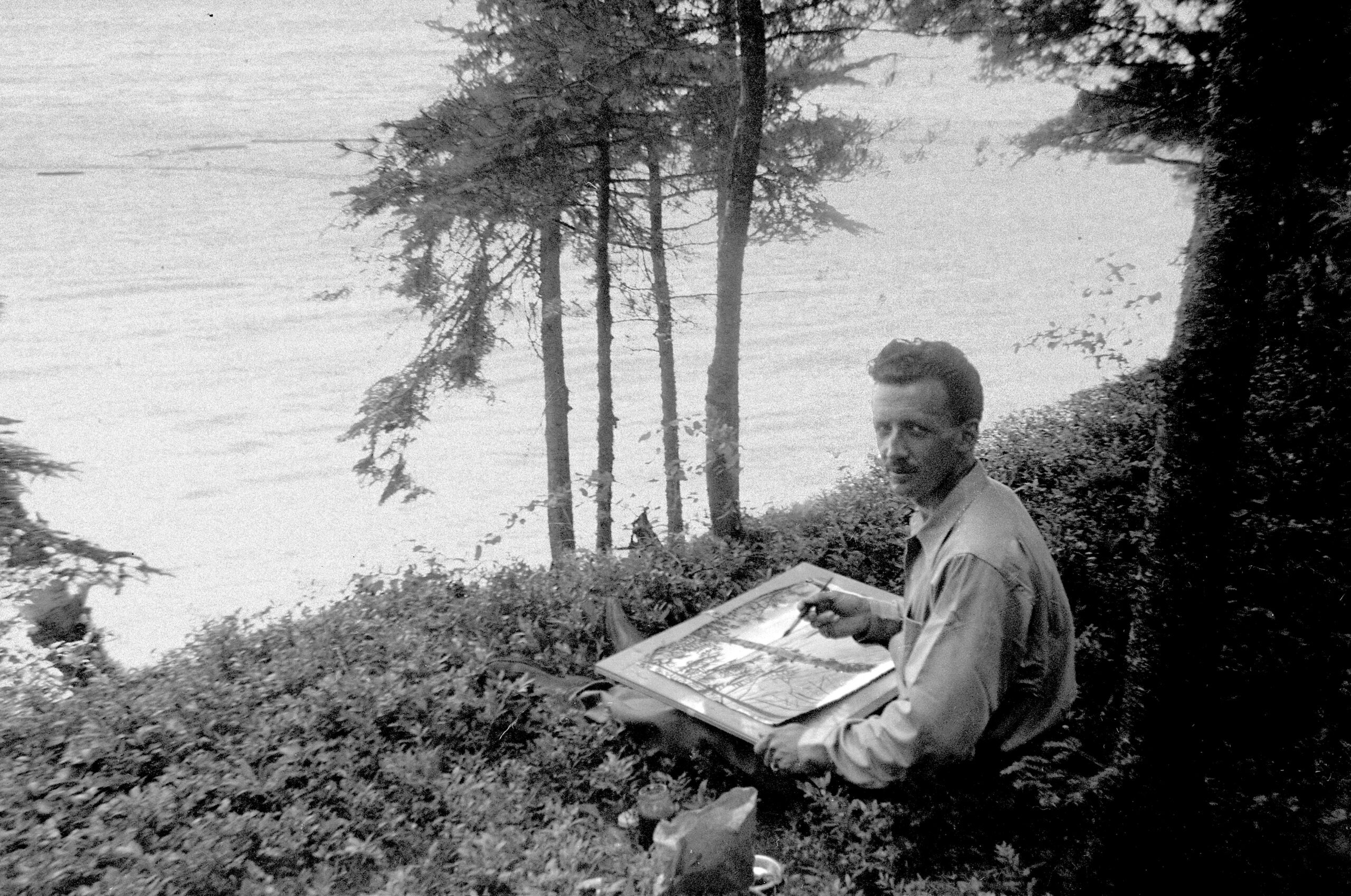
While the film, which is screening at AGGV until Sunday, September 6, spends much of its 80-minute runtime focusing on Hughes’ training as a painter and the struggle of finding purchase in the art world in the depression era—during which time people considered anything not necessary for survival a frivolity and a waste of money—it gives due diligence to other aspects of Hughes’ life as well. The narrative takes the time to explore the familial tragedies Hughes and his wife Fern struggled through, his constant search for solitude, and the brutal shock of going to the trenches of war as a government-mandated observer, to name just a few.
Edward John Hughes was born in 1913 in North Vancouver; he grew up in Nanaimo before training as an artist at the Vancouver School of Decorative and Applied Arts under the encouraging guidance of two members of the much-lauded Group of Seven, Frederick Varley and Lawren Harris. When World War II broke out in Europe, Hughes enlisted as a war artist, painting vivid works of military life during wartime. During this time, he developed his own unique style, imbued with the dreamlike quality of Henri Rousseau and the bold, vivid colours and chiaroscuro of Emily Carr, as well as his singular ability to paint raw emotion into life on the canvas.
He was eventually discharged and briefly made a home in Victoria before ultimately settling in nearby Shawnigan Lake with Fern, finally securing the quietude he had long sought. There, he painted idyllic images of the lakefront and the ocean at nearby Cowichan Bay.
As his reputation grew, his paintings joined the collections of galleries as far away as Montreal, eventually being commissioned by the Canadian Pacific Railway to paint murals on the interior walls of their transcontinental trains, as well as being commissioned to travel to San Francisco and depict British Columbian life in murals at the 1938 World’s Fair.
After this storied life was brought forth in documentary form and delivered to the public by Strom, interest in Hughes’ art surged, and one of his paintings, Entrance to Howe Sound, sold just weeks later on November 29, 2025, at auction for $4.8 million, approximately double what his paintings had fetched previously.
This sale was soon supplanted as most expensive Hughes painting by the May 2026 acquisition at auction of Coastal Boats Near Sidney, BC by a private collector for $5.7 million. It’s the most expensive painting ever sold by a BC artist, as well as the fourth-most-expensive piece of Canadian art to be sold at an auction.
Beautiful, yet produced in such a way as to be accessible to laymen of the art world, The Painted Life of E.J. Hughes is well worth taking the time to see, and you can also scope an E.J. Hughes original, Steamer Arriving at Old Wharf, Nanaimo while you’re at the gallery.