Camosun and the team at Eyēʔ Sqȃ’lewen Centre for Indigenous Education & Community Connections are bringing the well-being of Indigenous students into focus with a series of pop-up events that take place on Mondays at the Interurban campus and Tuesdays at the Lansdowne campus.
The program is known as ÍY, SET, a phrase that means “to better oneself” in SENĆOŦEN, the ancestral language of the W̱SÁNEĆ people, whose traditional, unceded territories the campuses sit on. The name ÍY, SET was given to the initiative by Indigenous student support staff and SENĆOŦEN scholar SDEMOXELTEN (Ian Sam) of the Tsartlip First Nation, who helped to build the early iterations of this project last year as a way to foster community among Indigenous students.
“The idea was to have a recurring event weekly at each campus so that students could not only feel that sense of belonging, but for it to be easily added within their schedule so that once a week they knew that they could come gather, have a hot lunch,” says Camosun Indigenous special projects lead and events coordinator Levi Glass.
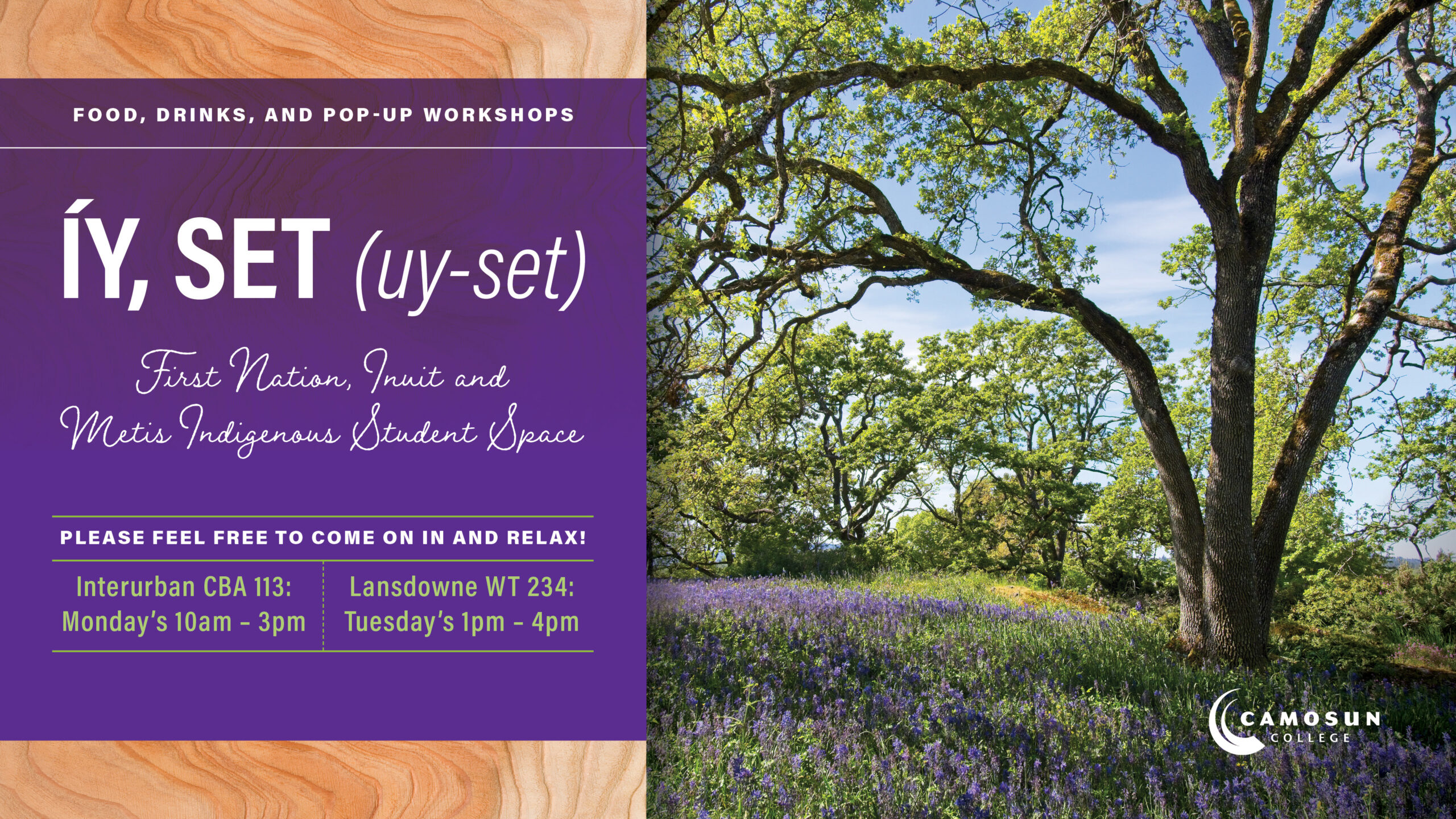
Ultimately, the initiative is a place for Indigenous students to gather and feel comfortable, but Glass assures that no one is excluded.
“So that’s sort of the basis for the event, setting up a space for Indigenous students to gather,” he says, “although frequently, the students have opened it up to all students. Other international students have often come, especially as invitations from the [Indigenous] students that do come.”
ÍY, SET will feature workshops focused on an array of Indigenous-focused areas, highlighting and linking themes like traditional beadwork and sustainability.
“I mean, certainly everyone’s welcome for the workshops. If you think of yourself as an ally, you’re certainly welcome,” says Glass. “We did one [workshop] in partnership with the Metis Nation of British Columbia. Melanie Teunissen works there as a cultural coordinator, and she did a beading workshop with us at Interurban,” he says. “That was beading the ‘every child matters’ pins in anticipation of Orange Shirt Day, and it’s likely that we do another one with her just before Remembrance Day, beading poppies at both campuses… to go from the disposable poppy to a beaded, precious one.”
The workshops, as well as the smaller, quieter events, are organized in such a way that even those who are unable to attend are not left out.
“Melanie has given us—and will in the next one—a bunch of kits for people who aren’t there to take home,” says Glass. “I know that when I was a student, my schedule was quite frantic and busy, and if I knew that something was happening weekly, I was more likely to go to it. But it’s also not always a big thing; it’s not always like there’s such a focus. You could just come and work on your homework and have coffee and have soup and just be. Have it as your base.”
With this initiative coming to life across campuses, Glass points out that there are also other ways for students to find community and support at Camosun.
“The other thing I might mention is that there’s a ‘request an elder’ info page and graphic going out, and that’s another thing that maybe students—even non-Indigenous students—could be aware of that they can access if they wanted to meet [with] an elder, whether they were doing research or were going through a difficult time. There are so many resources at the college, whether it’s through counselling or student services or also through Eyēʔ Sqȃ’lewen, with our academic advisors, our elders.”
ÍY, SET’s roots in the Camosun community are deep, with the ideals of one of the college’s own held at its heart. The late Skip Dick was a Songhees Elder and a beloved member of the Camosun community who worked with the college to promote Indigenous education and cultural understanding in these halls for over 50 years.
“We’re trying to carry the idea that Dr. Skip has talked about: the college being like a home away from home for Indigenous students, and I think that sort of idea of feeding and creating this welcoming space. We want this place to be a home away from home for everyone to feel welcome. These spaces are also for students to support other students and meet each other… It’s more about us bettering each other and creating that space where we can get together and share knowledge, break bannock, sit together.”