
In 1571, French writer Michel de Montaigne began writing a series of essays that would eventually serve as a literary self-portrait, perfectly encapsulating his character and personality. He often wrote about the physical and mental experiences of approaching one’s own death, believing his demise was surely impending.
The first two volumes were published in 1580, and the third in 1588, just four years before he died. Each essay varied in length and covered a multitude of topics, garnering attention for their style, which was unusually informal for the time. His writing was uniquely honest, and now, Montaigne is widely considered to be the father of the modern essay, introducing personal prose as a legitimate literary form.
Today, most of us understand essays as pieces of writing that present an argument or follow a particular subject. Structurally speaking, they are technical, informative, and precise. Right? Well, not always.
The word essay originates from the French term essai, meaning “to try,” and this is how Montaigne intended his writing to be. Unlike most writers of his time, he wasn’t concerned with perfection so much as expression. The goal of his writing was to convey something about himself and his understanding of the world, effectively explaining his free-form style.
By this translation, the word “essay” is not just a noun, but a verb. It is an action, and therefore, demands effort; that is all it demands. You don’t need to be the most articulate, skilled writer on the face of the earth to produce an essay worth reading. And, likewise, you don’t need to be a fierce academic to appreciate and indulge in essays.
There was a time in my life when I viewed essays as nothing more than the dead weight of a body being dragged across a finish line. They were academic chores; a means to an end. I think a lot of us have negative associations like this, and, as a result, we abnegate the simple act of reading and writing altogether, often due to a self-conceived predetermination that we won’t be any good at it. Now, I hate to be the bearer of bad news here, but if you walk through life thinking your capacity for excellence is limited only to what comes naturally to you, you will never get anywhere. Trust me.
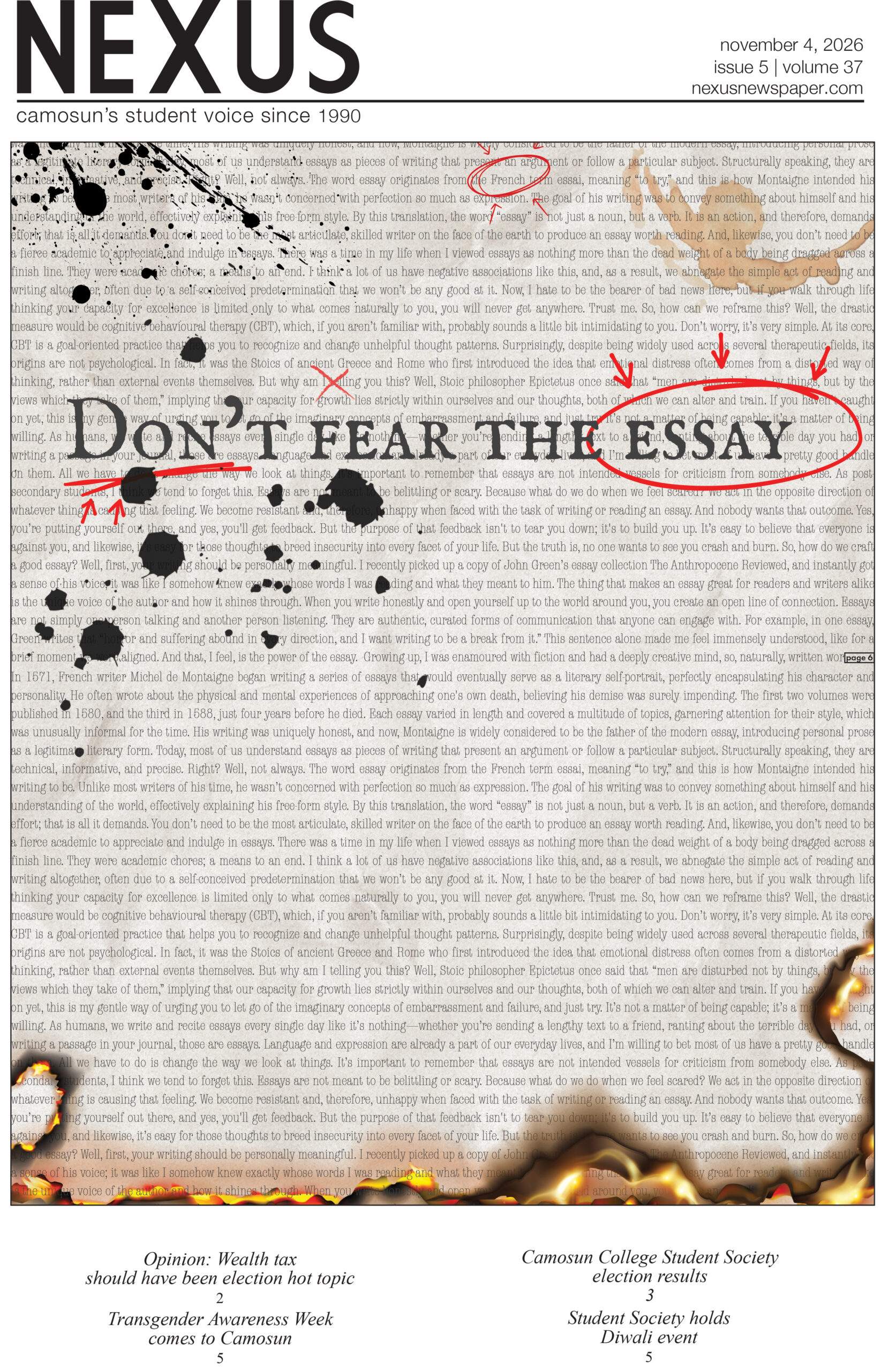
So, how can we reframe this? Well, the drastic measure would be cognitive behavioural therapy (CBT), which, if you aren’t familiar with, probably sounds a little bit intimidating to you. Don’t worry, it’s very simple. At its core, CBT is a goal-oriented practice that helps you to recognize and change unhelpful thought patterns. Surprisingly, despite being widely used across several therapeutic fields, its origins are not psychological. In fact, it was the Stoics of ancient Greece and Rome who first introduced the idea that emotional distress often comes from a distorted way of thinking, rather than external events themselves.
But why am I telling you this? Well, Stoic philosopher Epictetus once said that “men are disturbed not by things, but by the views which they take of them,” implying that our capacity for growth lies strictly within ourselves and our thoughts, both of which we can alter and train.
If you haven’t caught on yet, this is my gentle way of urging you to let go of the imaginary concepts of embarrassment and failure, and just try. It’s not a matter of being capable; it’s a matter of being willing.
As humans, we write and recite essays every single day like it’s nothing—whether you’re sending a lengthy text to a friend, ranting about the terrible day you had, or writing a passage in your journal, those are essays. Language and expression are already a part of our everyday lives, and I’m willing to bet most of us have a pretty good handle on them. All we have to do is change the way we look at things.
It’s important to remember that essays are not intended vessels for criticism from somebody else. As post-secondary students, I think we tend to forget this. Essays are not meant to be belittling or scary. Because what do we do when we feel scared? We act in the opposite direction of whatever thing is causing that feeling. We become resistant and, therefore, unhappy when faced with the task of writing or reading an essay. And nobody wants that outcome.
Yes, you’re putting yourself out there, and yes, you’ll get feedback. But the purpose of that feedback isn’t to tear you down; it’s to build you up. It’s easy to believe that everyone is against you, and likewise, it’s easy for those thoughts to breed insecurity into every facet of your life. But the truth is, no one wants to see you crash and burn.
So, how do we craft a good essay? Well, first, your writing should be personally meaningful. I recently picked up a copy of John Green’s essay collection The Anthropocene Reviewed, and instantly got a sense of his voice; it was like I somehow knew exactly whose words I was reading and what they meant to him.
The thing that makes an essay great for readers and writers alike is the unique voice of the author and how it shines through. When you write honestly and open yourself up to the world around you, you create an open line of connection. Essays are not simply one person talking and another person listening. They are authentic, curated forms of communication that anyone can engage with.
For example, in one essay, Green writes that “horror and suffering abound in every direction, and I want writing to be a break from it.” This sentence alone made me feel immensely understood, like for a brief moment we were aligned. And that, I feel, is the power of the essay.
Growing up, I was enamoured with fiction and had a deeply creative mind, so, naturally, writing had always been a reprieve for me. I was the proud architect of a thousand different realities and could flip from one world to the next in only a matter of minutes. Fiction made me feel safe. But for a long time, this love affair with figments ultimately kept me from indulging in anything else.
I always wanted to be somewhere I wasn’t. I wanted to escape. But eventually I came to the realization that all fictional stories are rooted in reality, and that reality is pretty subjective. Essays have the unique ability to reflect that clearly and openly.
As I write this, there are roughly 8.3 billion people inhabiting our planet, which then amounts to roughly 8.3 billion different experiences, beliefs, emotions, and thoughts. And while some things are universal—illness, hunger, heartache—we all have different associations with them, and it’s important to explore those.
So what’s the best way to navigate the machinations of your inner world? Well, you could watch movies from different countries (I recommend the 1983 Scottish film Local Hero), listen to every kind of music you can think of, and, of course, read and write essays about absolutely anything.
In post-secondary, most of the essays we read and write involve some kind of textual analysis, but that shouldn’t feel limiting to you. Oftentimes, we hear the word “analysis” and do a mental eye roll. But why? Well, usually it’s because we have these preconceived notions about literature and logic, and make the same assumptions whenever they come up, regardless of context. Really, all analysis does is open the door for broader conversations and allow us to explore counterarguments.
Counterarguments can be useful tools when crafting (or reading) an essay. When we identify perspectives that challenge our stance, we engage more deeply with the material. We find new ways to strengthen our arguments or, sometimes, even change them. Basically, we practice empathy.
Now, I’m sure I don’t have to tell you that empathy is a crucial part of the human experience, if for no other reason than it calls into question how we perceive the world around us and why. Further, when we read an essay, we effectively absorb another person’s inner consciousness. We’re tasked with following a foreign train of thought, not knowing when or where it will stop.
For this reason, I find it exceptionally valuable to engage with essays written by people whose lives are wildly different from my own. When we do, our ability to comprehend social, cultural, and political differences increases. We learn to develop an understanding of the world, rather than try to escape from it. Now, that’s not to say that escapism should never have a place in our lives. Just that it’s more conditional.
On a similar note, I’ve also found value in cross-pollinating my education, so to speak. This semester, I’m challenging myself by taking several classes unrelated to my major, including political science and geography. I think we can gain a lot from branching out and having experiences we otherwise never would’ve considered.
Our lives are very self-centred, and while that’s fine in its own right, it’s not without its side effects. So easily we miss the endless crossovers that are constantly at play in our world. We assume things aren’t as connected as they are and fall into a self-made trap of isolation. We stagnate ourselves, weighed down by our desire to be immediately good at things or not do them at all.
A thing is not worth doing just to be great at it, and this is a lesson that so many of us forget as we get older. Cliche as it is, it’s important to try new things. It’s important to be bad at things before you can be good at them, and that takes a level of discipline that not a lot of us have. But when we fail to make an effort, we condemn ourselves to a one-note way of life.
All of us want to be well-rounded, right? We want to be interesting and worth knowing. Well, the first step is considering what it takes to get there.
In my opinion, when we open ourselves up to the world around us, engaging with people and their stories, we learn a little something about how to be and how not to be. And I know all of this sounds, like, nauseatingly basic, but it’s a lesson worth relearning, especially now.
With the sudden rise in AI usage, we’ve become so grossly accustomed to this instantaneous pseudo-productivity that really requires no skill at all. You just enter a prompt and get a result; no real work involved. And I think what a lot of people miss is that the work, in itself, is the most meaningful part. We’re not cutting out the middleman by using generative AI; we’re cutting out the man, period.
It really feels like, these days, we’ve forgotten just how much the process matters. We now live in a world that is obsessed with outcome, not realizing that the process is ultimately what matters more. An essay isn’t interesting simply because it exists; it’s interesting because someone took the time to write it, edit it, and proofread it, then rewrite it again. It’s interesting because we can see the effort that was put into it. And we humans tend to act in the direction of whatever outcome we expect. So if we want to be good at something and hold ourselves accountable to that desire, we will put in the work. We must be willing to put in the work.
I think the real difference-maker is that, among many things, we’re able to recognize exactly what sparks creativity in people—and it’s usually boredom. You see, nowadays, with all this convenience, stimulation, and dopamine, we aren’t so willing to allow ourselves to feel bored, even just for a moment. But it’s in this nullified state that we can invent new ideas, create new things, and learn new skills. Boredom is the root of creativity and a necessary component of humanity. And when we allow others to think and feel for us, we start to lose hold of that humanity.
Gosh, where was I? Right, essays! Now, this isn’t to say that I’ve always been a lover of the essay. No. I mean, I was never particularly bad at them, but they left me vulnerable and opened me up to sometimes harsh criticism. I understand why someone would be uninterested in them. I’m just inclined to challenge that viewpoint.
Now, you might be asking yourself what the point is of engaging with this form of literature (or any literature, for that matter) outside of an academic context? Why waste your time writing about your life, or worse, reading about someone else’s?
Well, simply put, because they’re interesting. Not every essay, sure, but the beauty of this writing style is that you can zero in on absolutely anything you like. Your words don’t necessarily have to be educational (though they will almost certainly be insightful). And you don’t have to do a bunch of research on some niche topic no one’s ever heard of before; you can write about yourself, your experiences, or your life, because there is value in that.
And, you know what? I’m going to take this opportunity to let you in on a little secret: I haven’t really been trying to persuade you to write an essay. What I’m trying to do is help you see just how meaningful and diverse literature can be, because the human experience is, for all of us, just that.
Each of us harbours different interests, talents, and loud opinions. Some people lose themselves in the process of engineering, while others give themselves over to music. We are all different, and that’s what makes us pretty amazing. But how we learn to embrace those differences is largely dependent on how we present ourselves to one another.
Still having doubts? Well, just think about your textbooks. No matter the subject area, someone had to take the time to put their vast knowledge and experience down in words for you to read and hopefully learn from. They shared something with you: a part of themselves.
Now, broadly speaking, everyone has a story to tell. Articulation and expression are powerful skills that often require a great deal of creativity and curiosity. Are you curious? Are you someone worth knowing? How do you measure that? Honestly, what’s the point of all this?
Well, in my eyes, the point is to hold on to your humanity as tightly as possible, because, as John Green puts it, “when our light goes out, it will be Earth’s greatest tragedy, because while I know humans are prone to grandiosity, I also think we are by far the most interesting thing that ever happened on Earth.” The point is to tell your story and listen to others. Perhaps not to be remembered, but to be known.
The point is to hold on to yourself.