So, you’re thinking of doing a co-op, huh? Or maybe you have to, lest those pesky administrators keep your diploma all to themselves—and you deserve to have it, you worked hard for that! But, sadly, hard work doesn’t always translate to a six-figure salary and a nice benefits package. So, you and me, we’ve got to think critically.
It’s not unusual for college graduates to enter the workforce with little to show for it. I mean, sure, you got yourself a decent education, but that’s not exactly a rare find these days. In fact, more than 60 percent of working-age Canadians hold a credential from a college or university. Now, I’m sure I don’t have to tell you that that ain’t nothing. But don’t start worrying just yet: I’ve got good news for you.
Camosun College has the largest co-op program of any college in BC, meaning you have options. Using the career portal, which is available to all Camosun students, you can apply for job openings with companies like Seaspan, BC Ferries, the Fairmont Empress, and more.
“I think when students are choosing Camosun College, we’re very applied and hands-on with our course content,” says Camosun Business co-op internship coordinator Jennifer Phillips. “And I think that, coupled with the opportunity to do that work experience, is a really nice feature, and I think that’s what’s made Camosun actually quite successful.”
Before you can apply for a co-op, there are three boxes that need to be checked. First, you must be a current Camosun student. Sounds easy enough, right? Second, you must complete at least 8 courses with a minimum GPA of 3.0 (C+) prior to the start of your co-op. And, lastly, you must complete the Career Development Workplace Prep Skills course, otherwise known as CDEV WPS.
But I don’t want you to fret if none of this sounds up your alley, as there are plenty of other ways to gain work experience while studying here at Camosun. Some students do internships, others do practicums, and still others take on capstone projects.
“Co-operative education is a three-way partnership between a student, an employer, and the college,” explains Phillips. “And at Camosun College, we have quite a few programs. Most co-ops are optional, but there are a few that are mandatory. For most programs, they’re paid a wage; they usually work full-time, and in a position that would be related to their programs.”
This model allows students to gain industry experience one semester at a time, something that Yennefer Wilde, a Hospitality Management student who recently completed her first co-op with Orca Spirit Adventures, found invaluable, transferring her skills into something new and exciting.
“I worked for many, many years—like, a couple of decades—in social programs, managing homeless shelters and disenfranchised communities,” says Wilde. “I worked in senior living facilities for a while; I worked with Indigenous communities managing their housing portfolio for a bit. And, well, it broke my heart. That’s kind of the only way I can frame it.”
Eventually, that emotional strain led to Wilde shifting her career and setting her sights on something a little more sustainable.
“I was really burnt out from the work I’d been doing before,” says Wilde. “The pandemic knocked me right off my feet. So I decided that transitioning into the private sector would be a move that I could still use some of my old transferable skills in, but it’s way happier. People on holidays, people getting married. I don’t know. It just seemed so much more cheerful. And I figured the second half of my career, I just needed a little more joy. So I got into the Hospitality Management program.”
Of course, re-entering the workforce after such a long period away was intimidating, making the success of her work term all the more vital. Now, fortunately for her, she was able to settle into a position working under a recent Camosun graduate, whose familiar perspective offered some much-needed comfort and guidance.
“I was nervous leaving my old position,” says Wilde. “I left my old position with some pretty significant PTSD, and I was a homebody for a couple of years trying to recover from the overwhelm of navigating a lot of crises. And so going back out into the work world, it ended up being awesome and amazing and so well supported.”
While Wilde intends to enter the hotel industry, Orca Spirit Adventures provided her with a uniquely positive environment where she could get reacquainted with her professional life, solidify her career goals, and rebuild her confidence.
“When I was first looking for co-ops, I was really focused on what I should be doing,” says Wilde. “And then I ended up going with Orca Spirit. I mean, I want to get into working in accommodations and working in the hotel industry, and so working with Orca Spirit didn’t necessarily apply to my goal ultimately. But it really fed this like personal, historical thing… and it was something that brought me a little bit of joy.”
Through this experience, Wilde was able to brush up on her old skills while also learning new ones. And by facing the public again, she proved herself capable of pursuing the future that she had envisioned for herself.
“I have a pretty solid idea of where I want to go,” she says. “I think there was a moment where I was like, ‘this is so great. I just want to work here forever.’ And I think that because of the timing, it was good. It was a good feeling because I felt like I had kind of overcome this. I was so nervous about going back to work; I was so nervous that I would get triggered by customer complaints or something going on. And I thought I wouldn’t have the capacity to deal with it, but I did.”
While Wilde’s co-op placement served as a stepping stone for both personal and professional re-entry, other students have used Camosun’s co-op program as a launchpad to further their academic careers. For Leonardo Castro, a degree holder from Ecuador, completing a work term at the BC Cancer Agency could prove to be crucial in securing a spot in grad school.
Adapting to the language demands of a Canadian research lab is no small task. Not only that, but Castro has managed to balance conversational fluency with more precise, job-related technical vocabulary as well. During his work term with the BC Cancer Agency, he’s been able to hone these skills even further, setting himself up for his studies at the University of Victoria.
“I always had a goal in mind to go to grad school,” says Castro. “I want to study biochemistry with a cancer research specialization. It’s been a dream my whole life. I’ve wanted to do that since childhood. Someday, I want to develop the cure for cancer, but with time, you realize that there is a whole world right there, and even a small contribution can be really meaningful.”
At BC Cancer, that dream has materialized, although he did have to find the opportunity entirely on his own. This isn’t uncommon, but it does highlight a common criticism of Camosun’s co-op program: there just aren’t enough pre-approved employers for students to work with. This deficit places an unnecessary burden on students, many of whom are already juggling heavy course loads. However, for Castro, this added effort has yielded a deeply supportive professional environment.
“Working [at BC Cancer] is not just working. We have these meetings where all of us, from different departments, gather and present different types of information. So every day you learn something new. And all the people, they are willing to support you. They are willing to teach you what you don’t know.”
While Castro’s prior education has undoubtedly helped him navigate his own path, he also understands that not every student shares that same advantage; he says that Camosun should help students explore their options.
“Something that I [wish Camosun would] improve on is taking the opportunity to encourage students to find their real passion in a specific field,” he says. “Because, at least, when I came from my Applied Chemistry and Biology program, it’s like, what is that? What can you work at? I think if there is any chance for instructors or advisors to provide a student with a few options for what they can do in the future, it would be easier for students to have a clear focus.”
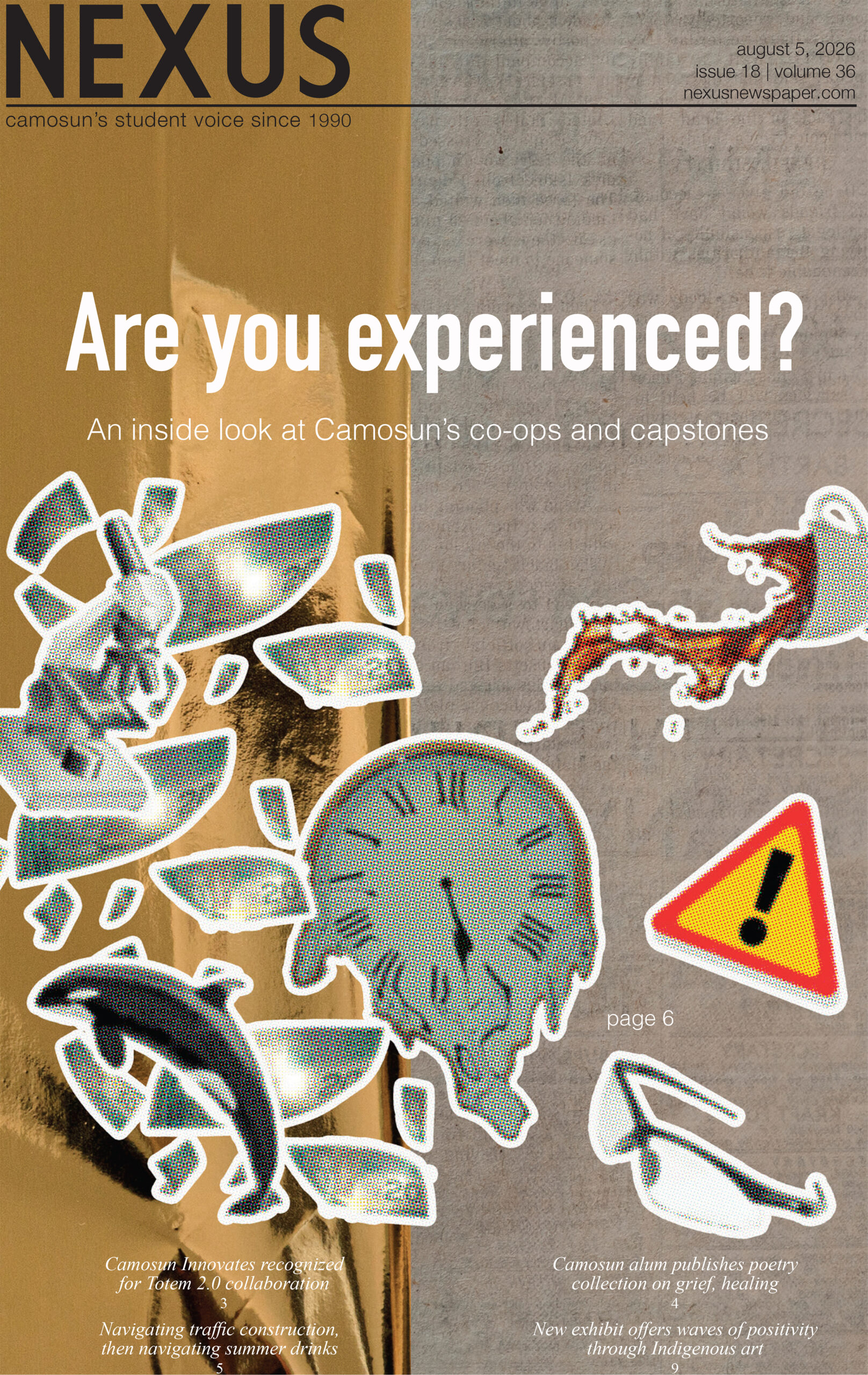
Last summer, Camosun took on its biggest capstone project to date, wherein five students worked together to produce an MRI simulator for Victoria General Hospital (VGH) that would allow children to familiarize themselves with the small space and loud noises and hopefully make the experience a little bit less uncomfortable for them. Bringing this idea to life, however, was anything but simple.
“[We felt] completely unprepared,” says team member Jeremy Turmel. “When we first started, we knew the project, so it’s not like we came in and were like, ‘Oh, we’re doing this out of nowhere.’ We knew the project; we signed up for the project. But we didn’t really expect it to be as big as it was. I think we were all shocked at how many hours we were going to have to put in, and what it was actually going to take to accomplish it.”
Turmel says that for these students, the average workday lasted about 10 to 12 hours, six days a week.
“It was very challenging for us, definitely, because we were skipping class a lot,” explains Turmel. “And we were definitely given a pity pass, I would say. We had some compassion from instructors who weren’t even involved because they knew the situation and the gravity of our project.”
Despite support from surrounding faculty, their busy schedules continued to prove unsustainable, says Turmel, taking a personal toll on the students.
“[The balance] was non-existent,” says Turmel. “We just did it because it felt like the right thing to do. Like, we have to show up to class; we need those credits to pass. But it almost felt like the class was a break from the project because we were so exhausted. We would go to class just to sit there and do nothing and not learn anything.”
Turmel says a big reason for that imbalance was that the mentor who was working with these students was also mentoring every other capstone project in the Mechanical Engineering department. (Jeffrey Stephen, the mentor for the project, was unavailable for comment at press time.)
“Camosun College should have seen that something was wrong,” says Turmel. “I don’t know about the capstones for this year or if they’re doing things differently now, but based on our experience, I don’t know how they could have allowed [our mentor] to put that much on himself. Because not only is it a problem for him to advocate for that, but then for the school to allow it to happen, that’s not okay.”
Camosun Mechanical Engineering chair Ross Lyle says that the project “grew to very high expectations not too long after the students started.”
“I mean, it was super impressive what the students and Jeff produced in the end, but it was not a simple project,” says Lyle. “This was a project of complexity that I hope we never experience again because it was just way over the top. It was over the top in terms of what the students got involved in, and it took a lot of effort on Jeff’s part after the students had finished the capstone term to finish up the project a lot on his own.”
Turmel says that as stress began to rise, the pressure that was placed on their mentor ultimately fell on the students.
“I think as timelines tightened, it became really evident that that was not a workload that I think anybody could’ve handled,” says Turmel.
Further constricting the project’s timeline were various administrative delays that stalled the budget—$26,000 donated from the Child’s Play Charity to VGH—from being released.
“Most of the projects had their funding immediately when they started, but we had to shuffle around with the funds because they didn’t know how they were going to give us the funds,” says Turmel. “So, it just came in a bit too late; like a month and a half, two months. And they had to do it through these prepaid Visa cards, and we had to go through them before we could purchase anything. We had to create accounts on sites so they could buy things for us.”
Perhaps ironically, despite the late funding and chaotic planning, this group had no other option but to succeed, says Turmel.
“[VGH] knew beforehand that [the project] may or may not be complete; it may or may not work,” says Turmel. “But then, throughout the project, it became ‘It has to work.’ Every other project, [Camosun] didn’t care. If it works, it works. If it doesn’t, it doesn’t. Who cares? But in our project, it was like, you have no other choice but for this to work and for it to be done at this time.”
Professional pressure aside, Turmel feels that there were also a number of safety concerns that the college failed to address. He says that before the project began, the school failed to provide a designated workspace or proper tools, forcing the students, as well as their mentor, to rely on their own personal belongings to complete the project. Additionally, he says the college failed to provide students with personal protective equipment (PPE) throughout this project.
“They didn’t have proper safety measures for us. No PPE was provided. And if you’re in a place of education, that’s their responsibility,” says Turmel. “If you’re working on a job site, that’s different. You bring your own stuff, and that’s your responsibility. But this is a place of education and learning. They need to provide that.”
“I know in the past, Jeff has been very focused on having students be properly protected,” says Lyle. “I can’t say that I know what happened in terms of students’ experiences. I would assume that they would have all been properly masked up and wearing glasses, and whatever else was required.”
In the end, this complicated experience did yield positive results. Not only did this group build lasting friendships and competitive resumes, but they also won the award for most innovative capstone project that year. And Turmel says that working with Island Health was a good experience.
“They were super accommodating to us, and super respectful and understanding, which was really important for the success of this project,” he says. “So I have to give them a lot of credit for that.”
“I think the students certainly can be very proud of what they accomplished in terms of the MRI project,” says Lyle. “But granted, it was a challenging experience… I mean, Jeff himself, he felt that the project was portrayed as one thing and then turned into something to be much, much larger than expected.”
It’s worth noting that the stakes of this project were highly unusual compared to other capstones, as most tend to operate on a much smaller scale. But there’s one more detail I forgot to mention: capstones, even at this level, do not pay, while the aforementioned co-ops offer you valuable career experience with a guaranteed paycheck to boot.
The MRI capstone, even though it was an anomaly, sheds a light on the reality of Camosun’s applied education program: simply put, it’s a double-edged sword. Because yes, it can be a deeply valuable experience both personally and professionally. But when an institution fails to provide adequate direction or oversight for its students, those students ultimately suffer.
In order for applied education to work, Camosun must be willing to protect, support, and guide its students. And, admittedly, they often do a pretty good job of it—I’ve had some amazing experiences with academic advisors and instructors here. But when negligence rears its head, even just for a moment, it’s important to reevaluate things.
For now, students have finished up their capstone projects for this year and they’ll be on display from 10 am to 2 pm on Friday, August 14 at the CETI building at the Interurban campus.
“[The MRI project] was an exception in term of what a typical capstone project is,” says Lyle. “Students are doing capstones right now, this term, and most of the capstones would fit on a tabletop.”